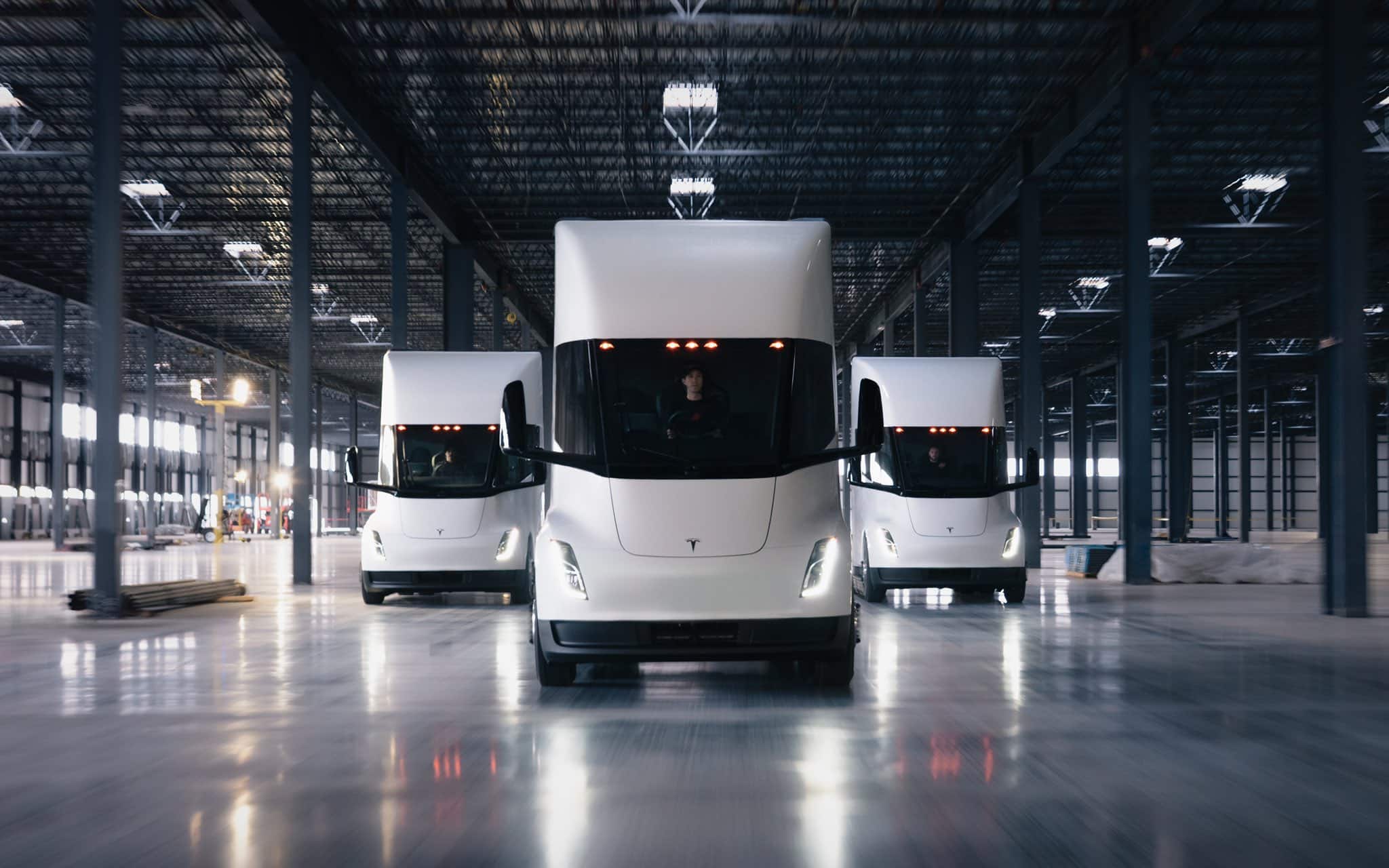
Tesla Semi’s Official Specs Revealed: 822 kWh Beast Reshapes Class 8 Trucking in 2026
Key Takeaways
- CARB’s April 2026 filing confirms Tesla Semi battery capacities: Long Range at 822 kWh, Standard Range at 548 kWh.
- Both variants use NCMA lithium-ion chemistry with shared peak motor power of 800 kW and steady-state of 525 kW.
- Estimated ranges align with Tesla’s claims: ~500 miles for Long Range (1.7 kWh/mile efficiency), ~325 miles for Standard Range.
- Key specs include GVW rating of 82,000 lbs, est. prices ~$290k LR / ~$260k SR.
- High-volume production ramping at Sparks, NV facility per Dan Priestley’s X post on April 29, 2026, with 4680 cell vertical integration.
- Tesla targets 50,000 trucks annually, capturing ~20% of North American Class 8 market.
After nearly a decade since its dramatic 2017 unveiling, the Tesla Semi is no longer vaporware—it’s rolling off production lines and poised to disrupt the $100 billion North American Class 8 trucking market.❶ ❷A recent California Air Resources Board (CARB) filing from April 2026 has spilled the beans on the truck’s core specs, confirming battery capacities, power outputs, and chemistry that make it a formidable contender against diesel giants. Coupled with high-volume production ramping at Tesla’s Sparks, Nevada facility—as announced by Semi Program Director Dan Priestley on X on April 29, 2026—this is the moment fleets have been waiting for.❸ ❷
In this deep dive, we’ll unpack the official numbers, analyze what they mean for efficiency and total cost of ownership (TCO), compare the Semi to rivals, and share insights on why now is the time for trucking companies to pivot to electric. I can tell you: the Semi isn’t just competitive—it’s set to dominate.
Breaking Down the Official Tesla Semi Specs
The CARB executive order provides the first regulatory-confirmed details on the production Semi’s powertrain. Here’s the headline data:
Battery Capacity and Range
- Long Range (LR) Variant: 822 kWh usable capacity, targeting ~500 miles of range at full 82,000 lbs Gross Vehicle Weight (GVW). ❶ ❸
- Standard Range (SR) Variant: 548 kWh usable capacity, ~325 miles of range under the same loaded conditions. ❹
These packs are smaller than some pre-production rumors (which floated 900+ kWh), yet Tesla achieves stellar efficiency: just1.7 kWh per mileloaded. That’s 20-30% better than early pilot fleets reported, thanks to aerodynamic tweaks, regenerative braking, and the truck’s low 23,000 lbs curb weight.❺For context, a typical diesel Class 8 burns 6-7 MPG, or ~1.5-2 gallons per mile—translating to far higher energy costs over time.
Powertrain and Performance
Both trims share identical electric motors:
Peak Power: 800 kW (1,072 hp)
Steady-State Power: 525 kW (704 hp)
0-60 mph: <20 seconds fully loaded (82k lbs GVW)
Top Speed: 65 mph (software-limited for efficiency)
No more guesswork—this matches Tesla’s website claims and crushes diesel acceleration while sipping energy.❸
Pro Tip for Fleets: The shared powertrain simplifies parts inventory and training. Pilots like PepsiCo have raved about the “instant torque” eliminating gear-shifting fatigue.❻
Pricing and Key Dimensions
- Estimated MSRPs: ~$260,000 SR / ~$290,000 LR (pre-incentives).
- GVW Rating: 82,000 lbs (standard Class 8).
- Charging: Megachargers deliver 70% SOC in 30 minutes via 1 MW+ DC fast charging.
Deep Dive: NCMA Chemistry and 4680 Cell Magic
The Semi’s batteries useNCMA (Nickel-Cobalt-Manganese-Aluminum) lithium-ion chemistryin Tesla’s proprietary 4680 cylindrical cells—a high-nickel formula (up to 90% Ni) stabilized by Al for thermal safety and cycle life.❸ ❼
Why NCMA Matters
- Energy Density: Higher Ni content boosts volumetric density over NMC, packing more kWh into less space/weight—critical for range.
- Durability: Rated for 1 million miles with minimal degradation; Al doping reduces cobalt dependency and cobalt-free risks.
- Cost Efficiency: Vertical integration at Giga Nevada slashes pack costs to ~$90/kWh at scale. ❶
Compared to LFP (used in some light-duty Teslas), NCMA prioritizes range over cost for long-haul. Early 4680 ramps faced yield issues, but 2026 production is “getting good,” powering the Semi’s vertical stack.❽
Insight: This chemistry positions Tesla ahead of rivals stuck on LFP or older NMC. Expect 4680s to migrate to Cybertruck and Robotaxi next.
Production Ramp: From Pilot to 50,000 Units Annually
Dan Priestley, Tesla Semi’s Director (and former intern!), dropped the bombshell on X: High-volume production isramping nowat the 1.7 million sq ft Sparks, NV factory—co-located with 4680 cell gigafactory.❾ ❷
- 2026 Outlook: “Many thousands” built this year, scaling to 50k annually by 2028—~20% market share. ❿
- Upgrades Since 2017: Gen 2 redesign includes larger cab, better aero mirrors, sleeper berth option, and refined batteries. ⓫
- Supply Chain: Megacharger network expanding; pilot fleets (e.g., Frito-Lay) validating real-world ops.
Recent tours (Jay Leno’s Garage, Out of Spec) show gleaming assembly lines— a far cry from 2023 delays.⓬
Opinion: Tesla’s factory playbook (from Model 3 Hell) ensures rapid scaling. Delays built resilience; 2026 is payback time.
Tesla Semi vs. Competitors: Why It Wins
Class 8 EV rivals lag:
| Truck | Battery (kWh) | Range (Loaded) | Price | Notes |
|---|---|---|---|---|
| Tesla Semi LR | 822 | 500 mi | ~$290k | 1.7 kWh/mi, 1M mi battery ⓭ |
| BYD 8TT | ~500 | 200 mi | $180k | Shorter range, lower power ⓮ |
| Freightliner eCascadia | 438-657 | 230-400 mi | $350k+ | Higher TCO, slower charge |
| Nikola Tre | 733 | 330 mi | $350k | Hydrogen focus, production woes |
| Diesel (Freightliner Cascadia) | N/A | 1,000+ mi | $170k | 2x fuel costs, emissions fines |
Key Edge: Semi’s TCO is now lower than dieselat scale—$0.10-0.15/mi vs. $0.25+/mi for fuel.⓯Drivers love the quiet cab and no blind spots.
Advice: For regional hauls (<325 mi), go SR to save $30k upfront. Long-haul? LR + depots.
The Bigger Picture: Emissions, Economics, and Advice for Fleets
Trucking emits 25% of U.S. transport CO2; Semis could slash that by electrifying 20% of the fleet.⓰With IRA incentives ($40k/truck) and falling grid costs, ROI hits in 2-3 years.
My Take: Skeptics called it hype, but specs prove Tesla engineered for reality. Competitors are suing over misleading claims? They’re scared.⓱
Fleet Action Plan:
- Pilot Now: Join waitlist; test via partners like UPS.
- Infra Prep: Install Megachargers ($50k/site).
- Financing: Lease for tax credits.
- Scale Smart: Start regional, expand to line-haul.
The Semi isn’t perfect—no 1,000 mi range yet—but it’s the catalyst for electrification.
Drive the Future or Get Left in the Dust
With production humming and specs verified, 2026 is the Tesla Semi’s year. This truck redefines heavy-duty EVs: efficient, powerful, scalable. Trucking’s diesel era ends here.
What do you think—ready to spec a fleet? Drop comments below!
Related Coverage
- Tesla Cybertruck steel supplier’s $1.7-billion TX facility is coming to form
- Tesla’s Secret Cybercab Car Wash in Las Vegas: Building the Ultimate Autonomous Fleet Hub
- Tesla’s Breathtaking New Blues: Marine Blue and Frost Blue Transform Model 3 and Model Y – A Deep Dive for Enthusiasts
- Tesla Model S owner shares remarkable battery and brakes update after 400k km
- Tesla will make some Superchargers publicly available to other EVs in 2022
- On the Shoulder of Giants: How the Tesla Cybertruck’s ambitious camper is willing itself into being