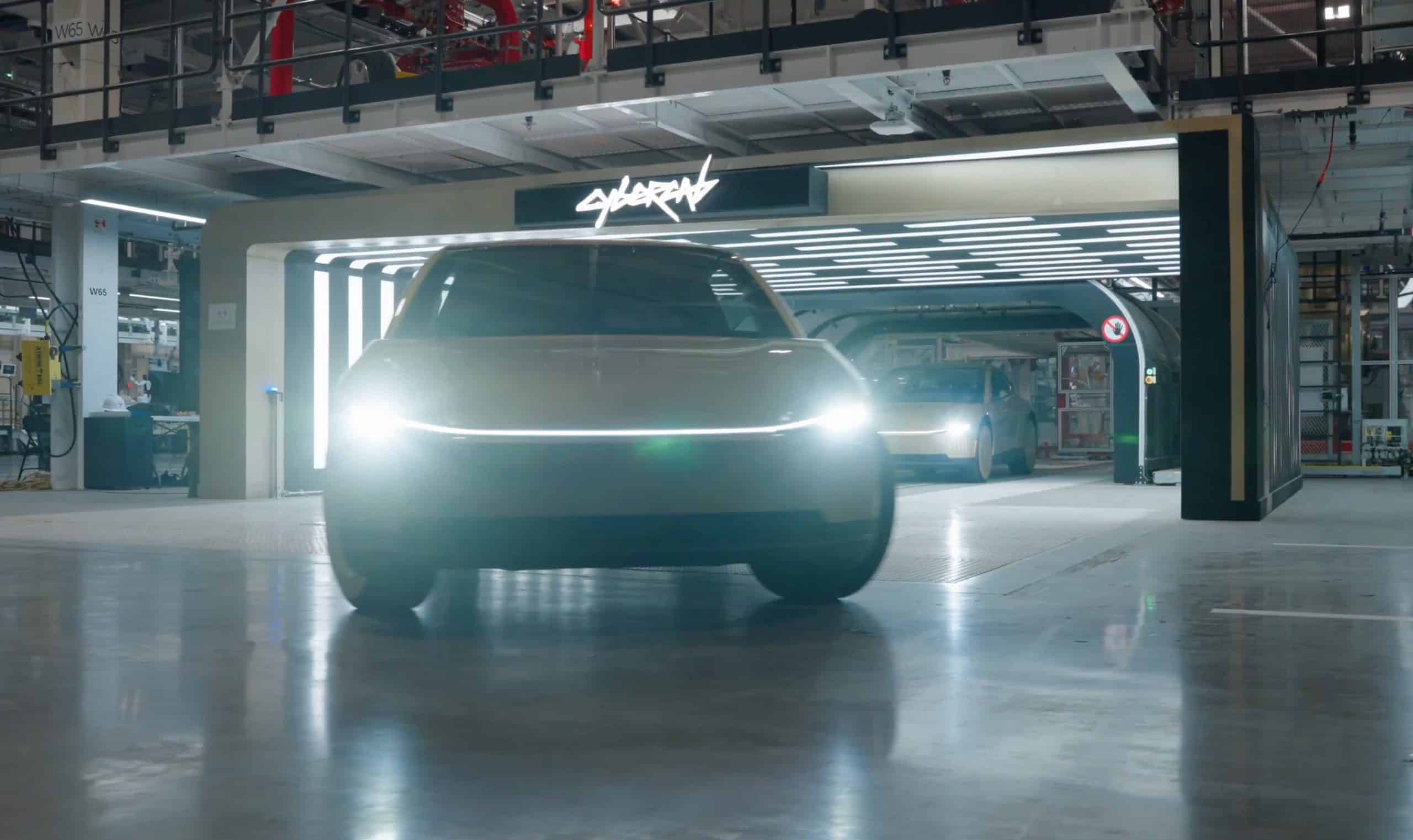
Tesla Cybercab Ignites the Robotaxi Revolution: First Production Units Autonomously Roll Off Giga Texas Assembly Line
Key Takeaways
- Tesla released video footage of a production Cybercab autonomously driving off the Giga Texas assembly line through a “Cybercab” tunnel to a holding lot.
- First Cybercab rolled off on February 17, 2026; Elon Musk congratulated the team on X: “Congratulations to the Tesla team on making the first production Cybercab.”
- April 2026 marked shift to volume production at Giga Texas, targeting hundreds per week; 60 units already spotted on campus.
- Revealed at October 2024 “We, Robot” event with 20 pre-production units giving rides.
- Musk stated operating cost ~$0.20 per mile and purchase price under $30,000.
- Two-seat design optimized for 90% of trips with 1-2 people, eliminating rear seats to cut complexity and cost for robotaxi fleets.
- Annual goal: 2 million Cybercabs once factories at full capacity.
- No steering wheel or pedals; relies on vision-based FSD, with video proving production-ready autonomy.
Imagine a sleek, wheel-less pod gliding silently off an assembly line, navigating tunnels and parking lots without a human touch—all on its own. This isn’t science fiction; it’s Tesla’s Cybercab in action, marking a pivotal moment in autonomous mobility. On the heels of its February debut, Tesla has shifted into high gear with volume production at Giga Texas, releasing jaw-dropping video footage that proves its vision-based Full Self-Driving (FSD) is production-ready.❶ ❷As a blogger who’s tracked Tesla’s EV odyssey for over a decade, Here is the bottom line: the Cybercab isn’t just a vehicle—it’s the dawn of a $10 trillion robotaxi economy, poised to upend urban transport, crush ride-hailing giants like Uber, and supercharge Tesla’s valuation.
In this deep dive, we’ll unpack the production timeline, design genius, eye-popping economics, and what it means for investors, cities, and everyday drivers. Buckle up (or don’t—Cybercabs have no seatbelts in the traditional sense).
The Historic Roll-Off: February 17, 2026 – Cybercab #1 Hits the Floor
Tesla’s Giga Texas factory in Austin made history on February 17, 2026, when thefirst production Cybercabrolled off the assembly line.❸ ❹Elon Musk wasted no time celebrating on X (formerly Twitter), posting: “Congratulations to the Tesla team on making the first production Cybercab.”❺This wasn’t a prototype; it was a fully built unit, complete with inductive charging capability and zero steering wheel or pedals.
What set pulses racing? Astunning video released by Teslashowing the Cybercabautonomously driving off the line, through a dedicated “Cybercab tunnel,” and into a holding lot. ❻ ❸No remote control, no safety driver—just pure FSD vision tech handling factory navigation. Drone footage from enthusiasts like Joe Tegtmeyer captured similar feats, with prototypes zipping around campus roads unsupervised.❼
Why this matters:Tesla has solved the “last inch” of factory autonomy, a feat competitors like Waymo still struggle with in real-world scaling. My take? This video is Tesla’s mic-drop to skeptics who’ve dismissed FSD as vaporware.
Key Milestones in the First Unit’s Journey
- Built Ahead of Schedule: Original targets eyed April 2026 for volume, but Tesla front-loaded with this pilot unit in February. ❽
- Team Celebration: Factory workers gathered around the pod, echoing Cybertruck’s debut vibes.
- Immediate Testing: Spotted in validation fleets shortly after, with 16+ units shipped for crash testing by March. ❾
From Hype to Hardware: The “We, Robot” Event That Started It All
Flash back to October 10, 2024: Tesla’s“We, Robot” eventat Warner Bros. Studios in Burbank, California, unveiled the Cybercab to a starstruck crowd.❿ ⓫Elon Musk arrived onstagein a Cybercab, one of 20 fully functional pre-production unitsgiving unsupervised rides to attendees.⓬ ⓭
The event was pure theater: lightbar-equipped pods with butterfly doors, Optimus robots dancing, and a teaser Robovan for 20+ passengers. Musk promisedproduction in 2026, no pedals/wheel, and rides costingless than a bus ticket. ⓮Over 50 autonomous vehicles were demoed that night, blending showmanship with substance.
Insider Insight: Critics called it a “nothing burger” for lacking timelines, but 18 months later, Tesla delivered. This event crystallized Tesla’s pivot from cars to autonomy, with Cybercab as the hero.
Giga Texas Ramp-Up: Volume Production Hits Stride in April 2026
By April 2026, Giga Texas flipped the switch tovolume production, targeting hundreds of Cybercabs per week. ⓯ ⓰Drone pilot Joe Tegtmeyer spotted60 unitsin the outbound lot on April 8—the largest sighting yet—parked alongside Cybertrucks.⓱ ⓲
Recent Q1 2026 earnings confirmed production is underway, despite no NHTSA cap on unsupervised FSD testing.❽Elon reiterated the timeline multiple times, noting the classic “S-curve” ramp: slow start, explosive growth.⓳
Production Timeline Breakdown:
| Phase | Date | Key Achievements |
|---|---|---|
| Pre-Production | Oct 2024 | 20+ units at We, Robot event ⓴ |
| First Unit | Feb 17, 2026 | Roll-off & autonomous video ❸ |
| Early Builds | Mar 2026 | 16+ shipped for testing ❾ |
| Volume Production | April 2026 | Hundreds/week; 60 spotted[21] |
| Full Capacity | 2027+ | 2M annually ⓰ |
My Prediction: By Q4 2026, expect 10,000+ units/month as unboxed manufacturing scales.
Design Mastery: Optimized for the 90% Use Case
Cybercab’s two-seat, two-doorlayout ditches rear seats, targeting90% of trips (1-2 people). ⓴ Features include:
- Vision-Only FSD: 8 cameras, no LiDAR/radar—cheaper, scalable.
- Inductive Charging: No plugs; wireless pads.
- Painted Aluminum Body: Cybertruck-inspired durability.
- Lightbar Aesthetics: Front/rear bars for futuristic flair.
No steering wheel/pedals means pure robotaxi focus—owners buy for fleets, not joyrides.Pro Tip for Fleet Operators: Integrate with Tesla Network for passive income; early adopters could see 30-50% utilization.
Game-Changing Economics: $0.20/Mile and Under $30K Price Tag
Musk’s bold claims: Operating cost ~$0.20 per mile(vs. $0.32 for Waymo), vehicle priceunder $30,000(possibly $25K at scale).[22][23]At 100k miles/year, that’s$20K annual ops—profitable from day one.
ROI Math for Investors:
- Daily revenue: 12 hours x 20 miles/hour x $1/mile fare = $240.
- Minus $0.20/mile ops = $160 profit/day.
- Yearly: ~$50K/unit after costs.
Opinion: This torpedoes Uber (human drivers cost $1+/mile). Tesla’s edge? Vertical integration + AI data moat.
The Road Ahead: 2 Million Units/Year and Global Domination
Tesla eyes 2 million Cybercabs annuallyat full tilt, dwarfing competitors.[24]Challenges? Regulatory hurdles (e.g., NHTSA approval), but Texas/California pilots are greenlit. By 2030, robotaxis could handle 50% of U.S. miles.
Advice for Readers:
- Investors: TSLA to $10T market cap on autonomy alone—buy dips.
- Cities: Partner with Tesla for congestion-busting fleets.
- Consumers: Ditch car ownership; summon a Cybercab for pennies.
In conclusion, the Cybercab’s autonomous debut at Giga Texas isn’t hype—it’s hardware reality. Tesla is rewriting mobility’s rules, one pod at a time. Stay tuned; the robotaxi era accelerates.
Related Coverage
- Tesla’s Cybercab Rolls Off the Line at Giga Texas: Ushering in the Autonomous Robotaxi Revolution
- Tesla’s Autonomy Blitz: Miami Pop-Up, Robotaxi Surge, and Cybercab’s Road to Revolutionizing Mobility
- Tesla Semi Hauls Cybercabs: Iconic First Delivery Signals Robotaxi Revolution from Giga Texas
- Tesla’s Optimus Revolution: From Fremont Pilot to Giga Texas Mega-Factory – The Dawn of 10 Million Robots Per Year
- Tesla Gigafactory Texas’ first Giga Press takes form at incredible pace
- Tesla’s Mysterious Model Y L Prototype at Giga Texas: A Game-Changer for American Families on the Horizon?