SpaceX’s Monumental Leap: Booster 19 Ignites All 33 Raptor 3 Engines in History’s Most Powerful Static Fire Test
Key Takeaways
- SpaceX completed a full-duration static fire of all 33 Raptor 3 engines on Booster 19 at Pad 2, Starbase, Texas—the most powerful rocket test in history.
- The test generated ~9,240 tons of thrust (280 tons per engine), enough to lift the Empire State Building.
- Prior test on March 16 was a 10-engine fire; Booster then got 23 more engines before today’s full test.
- Flight 12, Starship V3’s maiden voyage, is 4-6 weeks away, per Elon Musk on X.
- V3 stands 408 feet tall, capable of >100 tons to LEO in fully reusable config (vs. V2’s ~35 tons).
- Musk confident V3 achieves full reusability for economical Moon/Mars flights, as stated on X.
- V3 enables in-orbit refueling (e.g., 10 tanker flights for lunar missions), key for NASA’s Artemis program.
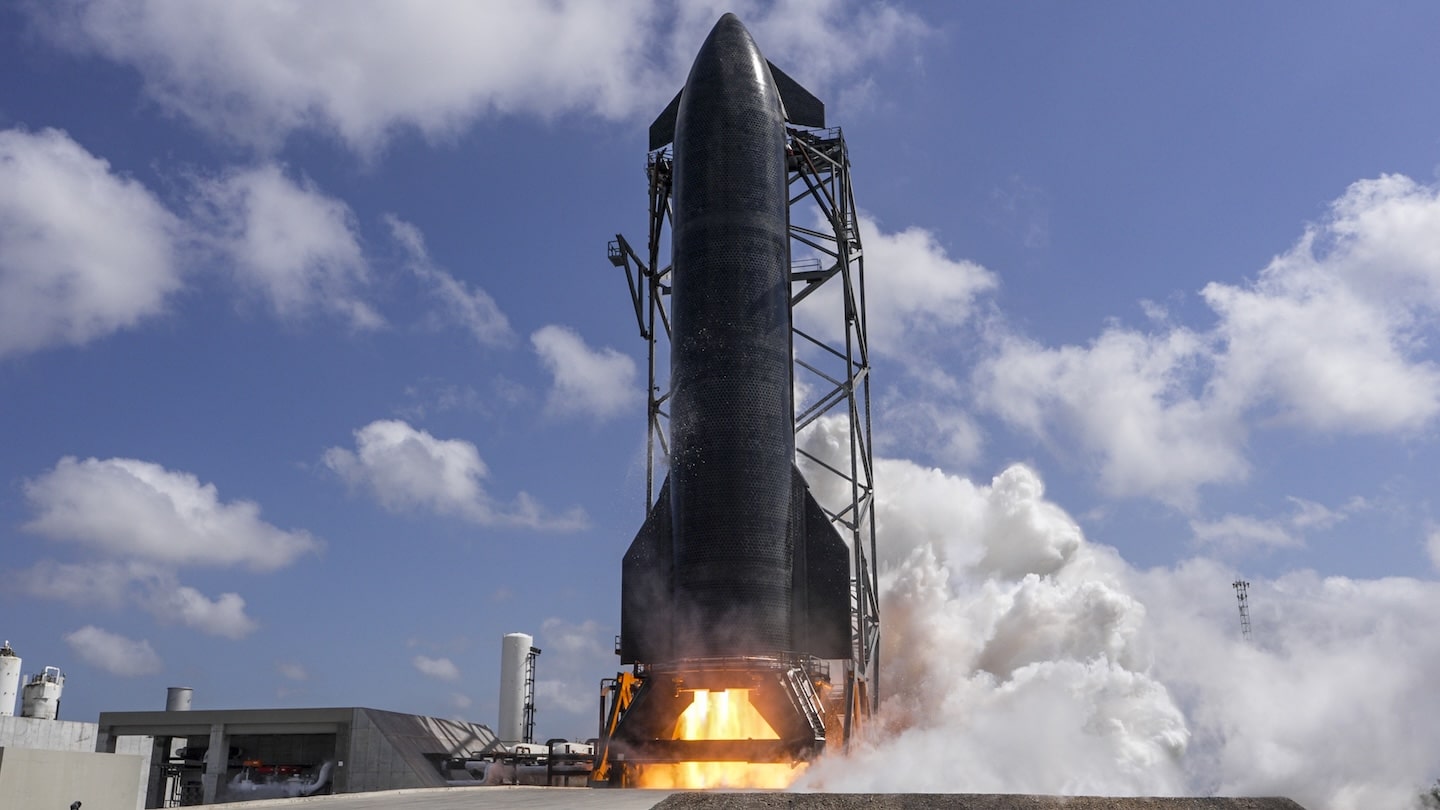
Imagine standing at Starbase, Texas, as the ground trembles under the raw power of 33 Raptor 3 engines firing in unison. On April 15, 2026, SpaceX achieved what can only be described as a historic milestone: afull-duration static fire testof Booster 19, the first Super Heavy booster fully equipped with the next-generation Raptor 3 engines.❶ ❷This wasn’t just another test—it generated approximately9,240 metric tons of thrust(280 tons per engine), equivalent to lifting the entire Empire State Building off the ground. This marks the dawn of truly operational Starship V3 hardware❸
In this in-depth post, we’ll dissect the test details, compare Raptor 3’s prowess, explore implications for Starship Flight 12, and analyze how this propels humanity toward reusable Moon and Mars missions. Buckle up—this is SpaceX rewriting rocket history.
The Test Breakdown: From 10 Engines to All 33
Booster 19’s journey to this epic static fire was methodical and iterative, showcasing SpaceX’s rapid development ethos.
Timeline of Booster 19’s Testing Campaign
- March 8-16, 2026: Initial Rollout and 10-Engine Fire
Booster 19, the inaugural V3 Super Heavy, rolled to the newly operational Pad 2 at Starbase. It underwent a propellant-loaded igniter test followed by a 10-engine static fire. Unfortunately, this test terminated early due to a ground support equipment (GSE) issue—not a booster fault—highlighting Pad 2’s teething problems as the first V3 test site. ❹ ❺ - Post-Test Upgrades: Installing the Full Engine Complement
After the partial fire, Booster 19 returned to the Mega Bay for integration of its remaining 23 Raptor 3 engines, bringing the total to 33. This rapid turnaround—mere weeks—demonstrates SpaceX’s high-volume engine production scaling. ❻ - April 2026: The Full Monty – 33-Engine Static Fire
Booster 19 rolled back to Pad 2, loaded with cryogenics, and executed a full-duration static fire of all 33 engines. Eyewitness accounts and SpaceX confirmations describe a flawless roar, with no reported anomalies. Boca Chica Beach closure and tank farm activity preceded the event, standard for high-thrust tests. ❼ ❷
This test’s scale dwarfs predecessors: Saturn V’s F-1 engines peaked at ~3,500 tons combined thrust. Booster 19’s 9,240 tons? That’s2.6x more powerful. ❽
Thrust Math: Why 9,240 Tons Matters
Each Raptor 3 delivers280 metric tons-force (tf)at sea level, up from Raptor 2’s 230 tf and Raptor 1’s 185 tf—a51% thrust leapfrom Gen 1 with fewer parts and lighter weight (1,525 kg per engine).❸ ❾
| Engine Variant | Thrust (tf) | Mass (kg) | ISP (Sea Level) | Key Improvement |
|---|---|---|---|---|
| Raptor 1 | 185 | ~2,000 | ~330s | Baseline methalox |
| Raptor 2 | 230 | ~1,630 | ~347s | +24% thrust, integrated lines |
| Raptor 3 | 280 | 1,525 | ~350s | +51% vs R1, 21% simpler ❿ |
Insight: Raptor’s evolution embodies “simplify to amplify.” Elon Musk teases Raptor 3.x hitting 300+ tf, pushing liftoff thrust toward 10,000 tons.❽
Starship V3: Bigger, Bolder, Reusable
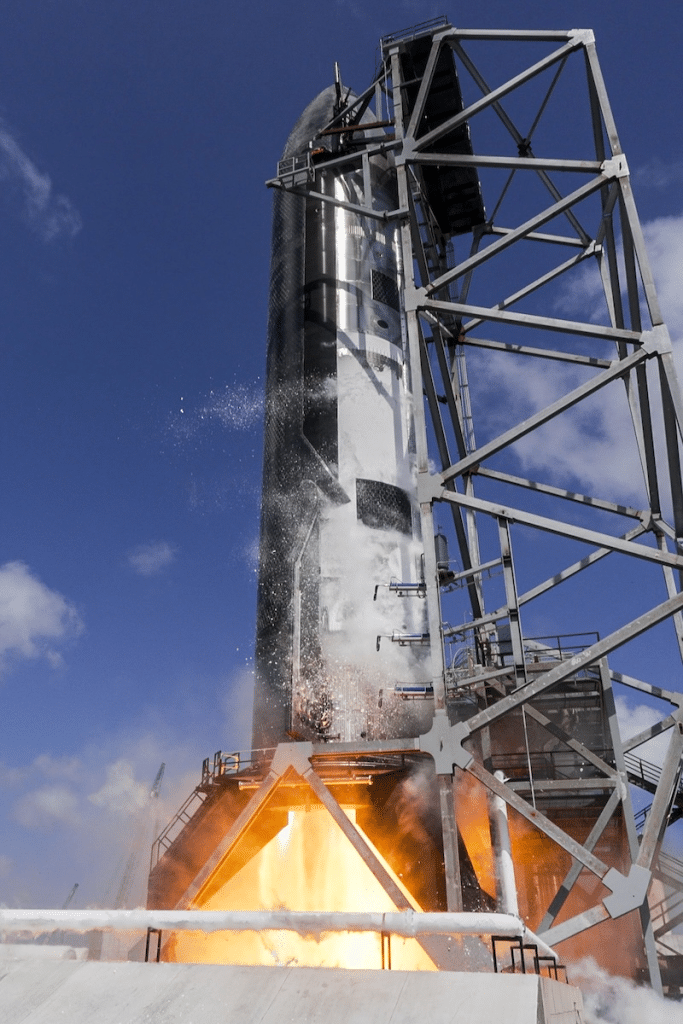
Starship V3 isn’t evolutionary—it’s revolutionary. Stretching to408 feet (124 meters) tall, it boasts:
- Payload: >100 tons to LEO in fully reusable mode (vs. V2’s ~35 tons). Expendable? 250+ tons. ⓫
- Reusability: Musk is “highly confident” V3 achieves full rapid reusability, enabling daily flights for Mars economies. ⓬
Flight 12: Maiden V3 Voyage Looms
Per Elon Musk’s X post, Flight 12 targets4-6 weeksfrom early April—mid-to-late May 2026. Delays (e.g., to early May) are routine, but this static fire de-risks it massively. Expect Ship 39 atop Booster 19, testing V3 catch mechanisms and orbital insertion.⓭ ⓮
What to Watch For:
- Booster catch by Mechazilla towers.
- Hot-staging refinements.
- Raptor 3 throttling for engine-out capability. ⓯
The Bigger Picture: Artemis, Refueling, and Mars
V3’s star power shines in NASA’s Artemis. In-orbit refueling—critical for lunar landings—requires ~10 tanker flights per HLS Starship. Demos target 2026, with crewed Artemis III by 2028.⓰ ⓱
Opinion: Skeptics doubt refueling’s feasibility, but SpaceX’s track record (Falcon reusability) proves them wrong. V3’s efficiency slashes tanker needs, making Moon bases viable. For Mars? 1,000-ship fleets become economical at <$10M per flight.
Challenges Ahead
- Regulatory Hurdles: FAA licensing for Flight 12.
- Pad 2 Maturation: GSE fixes post-March test.
- Scale-Up: Producing 500+ Raptors/year.
Advice for Enthusiasts/Investors:
- Track Live: Follow @NASASpaceflight, @BocaChicaGal on X for real-time updates.
- Invest Wisely: SpaceX private, but TSLA/Space ETFs benefit from Starship success.
- Visit Starbase: Ethical tours post-test; witness history.
Thrust Toward the Stars
Booster 19’s static fire isn’t hype—it’s proof SpaceX is lightyears ahead. With Flight 12 imminent, V3 unlocks solar system access. As Elon says, “full reusability for economical Moon/Mars flights.” Stay tuned; the stars await.⓬