 Gary Zhou
Key Takeaways
- The Boring Company signed a definitive agreement with Dubai’s Roads and Transport Authority (RTA) at the World Governments Summit 2026 to implement the Dubai Loop, its first project outside the US; signed by Mattar Al Tayer (RTA) and James Fitzgerald (Boring Company).
- Pilot phase: 4-mile (6.4 km) route with 4 stations linking Dubai International Financial Centre (DIFC) and Dubai Mall, paving way for full 14-mile (22.5 km) network with 19 stations including Dubai World Trade Centre, financial district, and Business Bay.
- Tunnels: 12-foot (3.6 m) diameter dedicated to vehicle transport, using cost-reducing methods with minimal surface disruption.
- Costs and timeline: Pilot ~$154M, delivery ~1 year after prep; full network ~$545M, ~3 years to implement.
- Capacity: Pilot route ~13,000 passengers/day; full route ~30,000 passengers/day.
- Mattar Al Tayer (RTA): Dubai Loop is a “qualitative addition” enhancing transport integration, first/last-mile solutions, with proven efficiency in capacity and costs.
- Steve Davis (Boring Company president): Partnership delivers “advanced, safe, and highly efficient tunnelling solutions” supporting Dubai’s sustainable mobility vision.
As a blogger specializing in cutting-edge urban infrastructure and futuristic transportation solutions, I’ve been tracking The Boring Company’s evolution since its inception. From backyard experiments to operational mega-projects like the Vegas Loop, Elon Musk’s tunneling venture has redefined how we think about beating traffic congestion. But the latest bombshell? A definitive partnership with Dubai’s Roads and Transport Authority (RTA) to build the Dubai Loop – the company’s first-ever project outside the United States. Signed on the sidelines of the World Governments Summit 2026, this deal signals a massive leap for global mobility. ❶ ❷
Imagine zipping underground from Dubai’s glittering financial hubs to its iconic malls in minutes, bypassing surface chaos. This isn’t sci-fi; construction on the pilot phase kicks off late 2026. In this deep-dive post, I’ll unpack the project’s specs, timelines, costs, key players, and my expert take on why Dubai is the perfect proving ground – plus comparisons to Vegas and bold predictions for the future.
The Historic Signing: A Meeting of Innovation Titans
The agreement was inked amid the buzz of the World Governments Summit 2026, with Mattar Al Tayer, RTA’s Director General and Chairman of the Board of Executive Directors, representing Dubai, and James Fitzgerald, The Boring Company’s Global VP of Business Development, signing for Musk’s team. Senior officials from both sides witnessed the ceremony, underscoring the strategic weight of this collaboration. ❶
This builds on a 2025 feasibility study where RTA shared geotechnical data and The Boring Company delivered technical reports. Now, it’s go-time: finalizing designs, mobilizing teams, and securing ~48 permits plus 10 No Objection Certificates (NOCs) to start tunneling in the second half of 2026. ❶
Elon Musk himself hyped it on X: “Boring Company to build Dubai Loop!” – a nod to how this fits his vision of 3D urban transport to solve traffic woes without sprawling surface infrastructure. ❷
Dubai Loop Breakdown: From Pilot Sprint to Full Marathon
The project is phased smartly, starting small to prove the concept before scaling.
Pilot Phase: Quick Wins in High-Density Zones
- Route: A compact 4-mile (6.4 km) tunnel linking the Dubai International Financial Centre (DIFC) – Dubai’s Wall Street – to the colossal Dubai Mall, the world’s largest shopping center.
- Stations: 4 stations for seamless access.
- Capacity: ~13,000 passengers per day – ideal for testing real-world demand.
- Timeline: Delivery ~1 year after prep work wraps.
- Cost: ~$154 million USD. ❶ ❸
This pilot isn’t just a demo; it’s engineered for “first- and last-mile” connectivity, integrating with Dubai’s buses, metros, and rideshares to slash commute times.
Full Network: A 14-Mile Urban Arteries
- Expansion: Grows to 14 miles (22.5 km) with 19 stations, weaving through Dubai World Trade Centre, the financial district, and Business Bay.
- Capacity: Jumps to ~30,000 passengers/day.
- Timeline: ~3 years total implementation.
- Cost: ~$545 million USD. ❶
Tunnel Specs Across Phases:
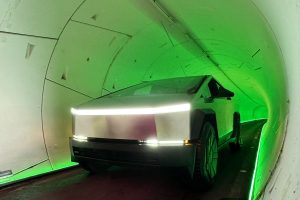
- Diameter: 12 feet (3.6 meters) – optimized for autonomous electric vehicles (think Tesla EVs in point-to-point “Loop” service).
- Tech: Prufrock-series boring machines for ultra-fast digs (up to 1 mile/week), minimizing surface disruption to roads and utilities. ❹
No Hyperloop here (yet) – this is practical, zero-emissions Loop tech: direct rides, no stops, all-electric. ❸
Leadership Insights: Quotes That Fuel the Hype
Dubai’s bold leaders are all-in:
“The project represents a qualitative addition to Dubai’s transport ecosystem, as it enhances integration between different mobility modes and provides flexible and efficient first- and last-mile solutions. Studies have demonstrated the project’s efficiency in terms of capacity and operating costs…” – Mattar Al Tayer, RTA. ❶
The Boring Company’s President Steve Davis echoed:
“We are proud to partner with the Roads and Transport Authority… to deliver advanced, safe, and highly efficient tunnelling solutions that support Dubai’s vision for sustainable and future mobility.” ❶
Sheikh Mohammed bin Rashid even reviewed the project alongside Glydways (another RTA innovation), cementing Dubai’s smart mobility push. ❷
Why Dubai? A Match Made in Urban Innovation Heaven
Dubai’s explosive growth – population doubling every decade, tourism booming – demands radical solutions. Surface traffic? Nightmare. RTA’s already delivered 67 rapid improvements in 2025 and plans 72 more roads/bridges by 2027. ❺ The Loop fits perfectly: low disruption in a city obsessed with speed and luxury.
My Insight: Dubai’s flat terrain and visionary funding (no red tape like US cities) make it Boring’s ideal international debut. Expect ripple effects – if successful, expect pitches to Singapore, Riyadh, or Shanghai.
Vegas Loop: The Blueprint for Dubai’s Success
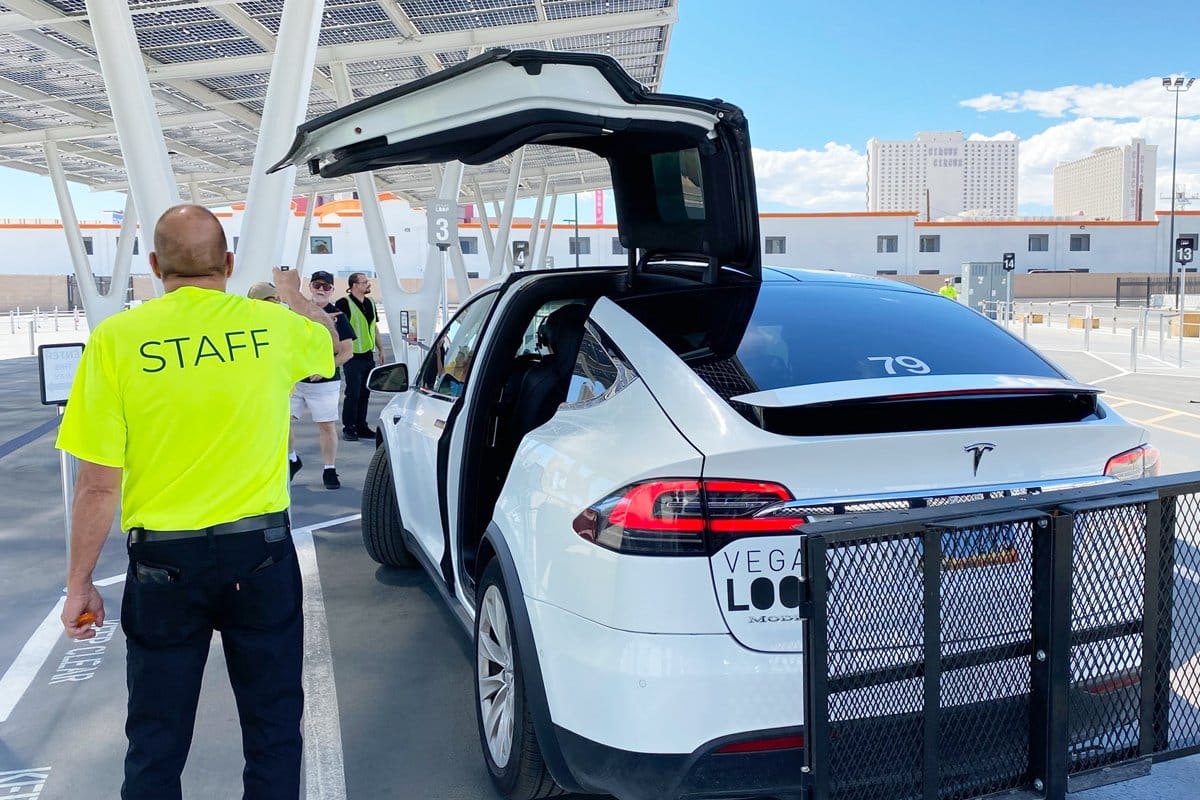
The Boring Company’s US flagship proves this works. Vegas Loop:
- Status (2026): Partially operational (8 stations, >3 million riders), expansions underway (e.g., Encore Connector opened 2025). ❻
- Scale: 68 miles approved, 104 stations planned; peak 90,000 passengers/hour.
- Wins: LVCC Loop cut 45-min walks to 2 mins; CES 2026 moved 90k+ riders. ❸
Dubai’s pilot capacity (13k/day) is modest by comparison but scales similarly. Lesson? Start operational fast, iterate.
Pro Tip for Cities Eyeing Similar Projects:
- Prioritize Prufrock deployment for speed.
- Integrate with existing transit early.
- Use Tesla AVs for safety/efficiency.
Challenges, Risks, and My Expert Predictions
No project is tunnel-vision perfect:
- Permits Hurdle: 48+ approvals in regulatory-heavy UAE.
- Desert Heat: Machines must handle 50°C+; Boring’s R&D tunnels prepped them. ❸
- Scalability: Full network at $545M is a steal vs. subways ($1B+/mile), but ops costs?
Opinion: Bullish. Vegas hit 3M riders; Dubai’s tourism (20M+ visitors/year) will crush targets. By 2030, expect Dubai Loop v2.0 airport-linked. Globally, this greenlights Boring’s export model – Music City Loop next? ❸
Advice for Investors/Planners: Track Q3 2026 tunneling starts. Diversify into EV infra stocks; Boring could IPO.
The Bigger Picture: Reshaping Cities Underground
This isn’t just tunnels – it’s Dubai leapfrogging to 3D mobility, aligning with RTA’s 2030 plan for integrated, innovative transport. ❼ For the world: Proof that private innovation + gov’t vision = traffic apocalypse averted.
The Boring Company now eyes international domination. Stay tuned – I’ll update as shovels hit sand.
What do you think? Will Dubai Loop redefine the Middle East? Drop comments below!