
 Gary Zhou
Key Takeaways
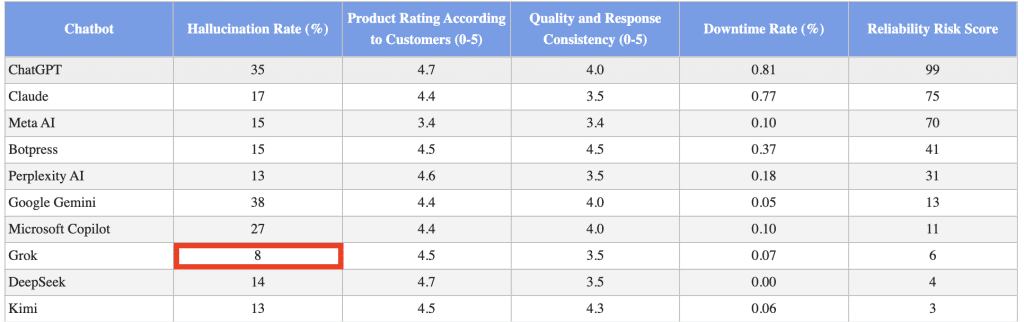
- Grok has an impressive 8% hallucination rate, making it the most reliable AI chatbot tested.
- ChatGPT scored poorly with a 35% hallucination rate and the highest risk score of 99.
- Relum’s study emphasizes the importance of choosing chatbots based on reliability for specific business needs.
- There’s a significant gap between chatbot popularity and performance, with Grok being more accurate yet less widely used.
- 65% of US companies use AI chatbots, highlighting their growing importance in the workplace.
In the ever-evolving world of artificial intelligence, chatbots have become an indispensable tool for businesses worldwide. As their integration into daily operations grows, the need for reliable, accurate AI becomes paramount. Enter Grok, Elon Musk’s brainchild, which has emerged as a standout performer in a recent study. This blog post delves into the reliability of Grok compared to other major chatbots, analyzing why it could be the ideal choice for your business needs.
Understanding AI Chatbot Reliability
Relum’s latest study on AI chatbot reliability provides key insights into how different chatbots perform in workplace settings. Let’s break down the findings and see what sets Grok apart from its competitors.
Key Statistics from the Study
- Grok boasts a remarkable hallucination rate of just 8%, making it the most reliable among the ten major models tested.
- ChatGPT, despite its popularity, recorded a 35% hallucination rate and the highest risk score of 99, indicating significant reliability issues.
- As a whole, the study emphasizes the crucial role of reliability in choosing AI chatbots tailored to specific business needs.
Why Hallucination Rates Matter
Hallucination in AI refers to the generation of false or misleading outputs, which can lead to critical errors, especially in business environments. Let’s explore why Grok’s low hallucination rate is significant:
- Accuracy-Critical Tasks: For industries where precision is crucial, like finance or healthcare, an 8% hallucination rate means fewer erroneous outputs and more trustworthy data handling.
- Business Credibility: Lower error rates translate to improved customer trust and business reputation.
- Time and Resource Efficiency: Solving fewer errors means spending less time on rectifications, ultimately benefiting a company’s bottom line.
Performance Beyond Hallucination
While hallucination rates are a critical measure, they are not the only factor. Other performance metrics evaluated in the study include:
- Customer Ratings: Grok achieved a strong 4.5 rating, indicating user satisfaction with its performance.
- Consistency and Downtime: With a consistency rating of 3.5 and a downtime rate of only 0.07%, Grok minimizes disruptions, enhancing reliable service delivery.
A Gap Between Popularity and Performance
Despite Grok’s superior performance, it is not as widely adopted as mainstream options like ChatGPT. This discrepancy highlights a gap where businesses are choosing popularity over effectiveness. It is crucial for companies to reassess their AI tools not just based on usage statistics but also on empirical performance data.
The Growing Importance of AI Chatbots
- Current Usage Trends: 65% of US companies are already integrating AI chatbots into their operations.
- Future Directions: As chatbot usage continues to rise, businesses must pivot towards more reliable solutions, ensuring they leverage technology that truly meets their specific needs and enhances operational efficiency.
Making an Informed Choice
The insights from Relum’s study offer a compelling case for scrutinizing AI chatbots through a lens of reliability. Grok stands out as a powerful option for accuracy-dependent fields, and its adoption could set a new standard in AI usage. As AI tools become further entwined with business processes, choosing the right chatbot will be key to maintaining competitive advantage.