 Gary Zhou
Key Takeaways
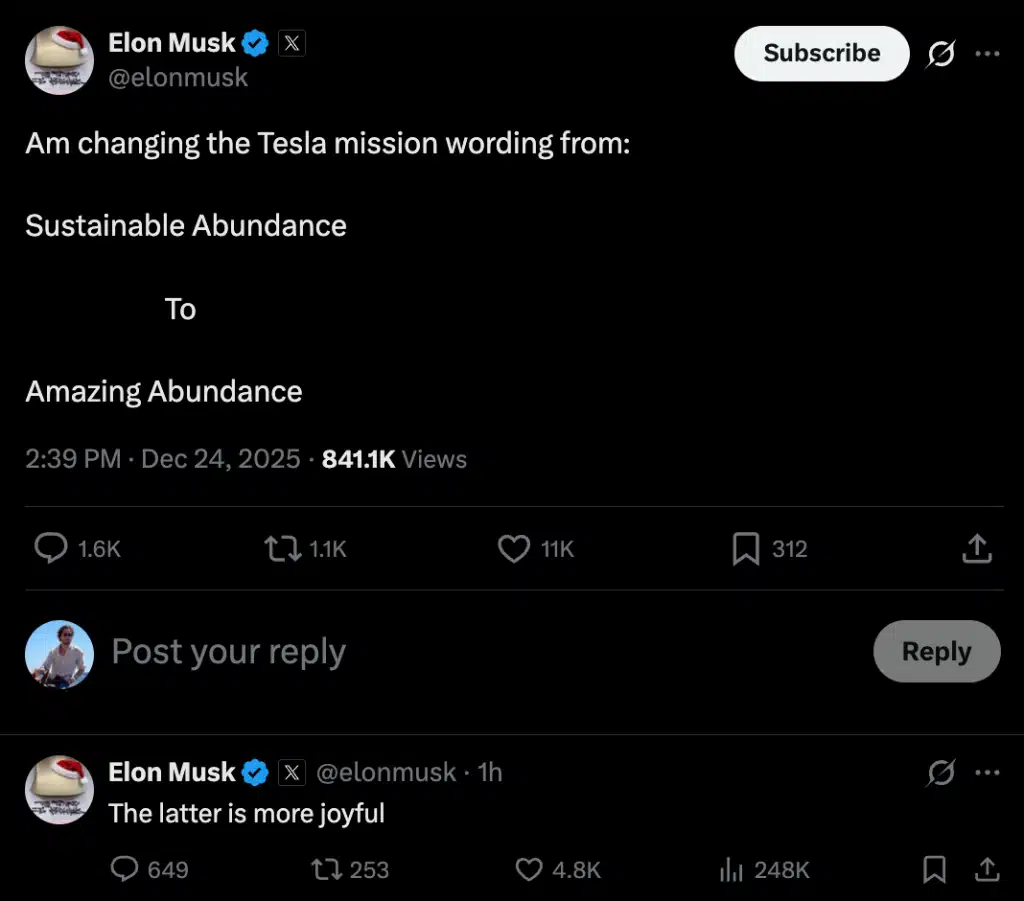
- Tesla’s mission statement has dropped the term “sustainable,” now focusing on “Amazing Abundance.”
- This change signifies a shift away from environmental goals toward a focus on economic abundance driven by technology and AI.
- Elon Musk emphasizes a future built on humanoid robots and Artificial General Intelligence (AGI) rather than sustainability.
- Critics, including Electrek’s Fred Lambert, express concern that this signals Musk’s detachment from climate issues and more focus on personal wealth.
- A noteworthy discussion by commentor EVPaddy highlights the contradiction in Musk’s messages regarding a “Universal High Income” without mechanisms for wealth distribution.
In a surprising yet revealing shift, Tesla, under the leadership of Elon Musk, has rebranded its mission, shedding its well-known “sustainable” ethos to embrace one of “Amazing Abundance.” This transformation marks a pivotal transition in Tesla’s trajectory, influencing not just its mission but also the broader conversation around sustainability, technology, and economic futurism.
A Shift in Mission: From Sustainability to Abundance
For years, Tesla’s mission has been synonymous with accelerating the world’s transition to sustainable energy. The very foundation of the company was built upon environmental stewardship and the pursuit of a greener planet. However, recent developments indicate a profound shift. The term “sustainable” has been removed completely, replaced by the ambitious new goal of achieving “Amazing Abundance.”
This change in mission reflects a strategic pivot from primarily focusing on environmental goals to emphasizing the potential of economic abundance powered by cutting-edge technology, particularly AI and robotics. As Tesla continues to innovate, it is now positioning itself at the forefront of a post-scarcity economy where resources are theoretically infinite thanks to technological advancements.
The Role of AI and Robotics in Tesla’s Vision
Central to this new mission are humanoid robots and Artificial General Intelligence (AGI), which Musk believes will drive global economic growth and prosperity. The aim is not merely to replace human labor but to exponentially increase productivity and resource availability. These technologies are perceived as the cornerstone of a future where abundance, rather than scarcity, shapes society.
However, this vision isn’t without scrutiny. Many observers, including critics like Fred Lambert from Electrek, worry that this new direction could signal a detachment from pressing climate issues. Instead of prioritizing environmental sustainability, Musk appears more focused on futuristic economic models, potentially prioritizing personal wealth accumulation.
Criticism and Conversations
Critics argue that while the promise of abundance is appealing, there remains a significant disconnect between the narrative and practical implications. EVPaddy, a prominent commenter in the Electrek community, highlights a crucial contradiction: the concept of “Universal High Income” lacks a clear mechanism for equitable wealth distribution. Without addressing economic inequality directly, there are fears that the benefits of such technological advancements may not trickle down to broader society.
This criticism underscores a larger conversation about the role of business leaders in addressing societal challenges. As Tesla redefines its mission, it also prompts a reevaluation of corporate accountability and responsibility, especially in terms of environmental impacts and wealth disparities.
Implications for Tesla’s Brand Image
Such strategic pivots inevitably impact Tesla’s brand image. Having built its reputation on green innovation and sustainability, the company’s new focus may confuse or even alienate some of its environmentally-conscious supporters. Brands thrive on clarity and consistency in messaging, and this change tests the boundaries of Tesla’s brand loyalty.
The implications of this realignment are multi-faceted, affecting investor perceptions, customer loyalty, and Tesla’s standing as a leader in sustainable technology. While some may see this as a bold step towards a futuristic vision, others may question the alignment of these goals with immediate environmental needs.
Final Thoughts
Elon Musk’s decision to rebrand Tesla’s mission statement marks a significant transformation in the company’s philosophy and strategic direction. As Tesla ventures into this new realm of “Amazing Abundance,” it stands at the intersection of technological innovation and ethical considerations. The coming years will be crucial in determining whether this bold vision aligns with the evolving expectations of stakeholders committed to sustainability and equitable economic progress.