 Gary Zhou
Key Takeaways
- SpaceX is preparing for Starship V3’s April test launch, featuring a taller Super Heavy booster and upper stage with upgraded Raptor 3 engines for stronger thrust.
- V3 boosts payload capacity to over 100 tons to low Earth orbit, up from 35 tons in predecessors, crucial for Mars cargo and colonization.
- Orbital refueling is a key upgrade, enabling Starship as a true deep space transport system for Moon and Mars missions.
- Fully reusable design targets a tenfold cost reduction per kg to orbit, unlocking satellite constellations, science, and human space travel.
- NASA plans Starship lunar South Pole mission in 2028 for a permanent crewed science station; V3 success keeps timeline on track.
- Elon Musk prioritizes self-sustaining Moon city first as proving ground before Mars, due to frequent access windows.
- Elon Musk hyped V3 launch on social media; SpaceX completed initial activation and cryogenic testing at Starbase Pad 2.
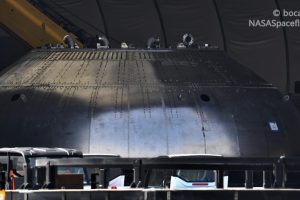
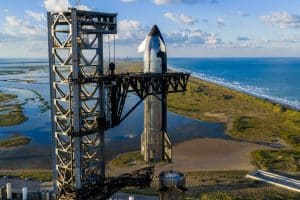
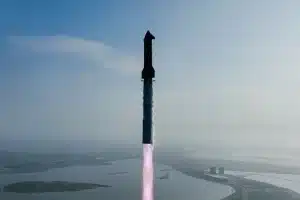
SpaceX is on the cusp of another monumental milestone with the anticipated April 2026 test launch of Starship V3, marking Flight 12 and the debut of its most advanced iteration yet. ❶ ❷ Originally targeted for the first quarter, the launch has slipped slightly due to rigorous testing, but recent successes at Starbase Pad 2 have SpaceX enthusiasts buzzing. Elon Musk himself hyped the event on social media, underscoring the vehicle’s taller Super Heavy booster, elongated upper stage, and next-gen Raptor 3 engines promising unprecedented thrust. ❸ As a space blogger with over a decade tracking Elon Musk’s ventures, I see V3 not just as an upgrade, but as the rocket that could finally make humanity multiplanetary—delivering massive payloads at a fraction of the cost.
In this deep dive, we’ll unpack V3’s specs, its revolutionary features like orbital refueling, ties to NASA’s lunar plans, Musk’s Moon-first strategy, and what it all means for the future. Buckle up; this is the future of spaceflight.
The Evolution: What Makes Starship V3 a Beast?
Starship has iterated rapidly since its early prototypes, but V3 represents a quantum jump. Here’s a breakdown:
Key Hardware Upgrades
- Taller Super Heavy Booster: Stretched for more propellant, powered by 33 Raptor 3 engines—SpaceX’s lightest and most efficient yet at just 1,525 kg each, with simplified plumbing for higher reliability. ❹ ❺ This booster alone generates over 16 million pounds of thrust at liftoff. ❻
- Extended Upper Stage (Ship): More fuel capacity and six Raptor engines (three sea-level, three vacuum-optimized).
- Raptor 3 Engines: Thinner (1.3m diameter), shorter (3m long), and packing 226 kN thrust per engine— a massive efficiency gain over Raptor 2. ❼
These changes make V3 bigger, stronger, and more reusable than V1/V2, which topped out at around 35 tons to low Earth orbit (LEO).
Recent Testing Triumphs at Starbase Pad 2
SpaceX wrapped up initial activation and cryogenic testing on Booster 19 (the first V3 Super Heavy) at the shiny new Pad 2. Over several days, teams loaded super-chilled liquid methane and oxygen, proving the propellant systems and structural integrity—despite a brief static fire hiccup due to ground issues. ❽ ❾ ❿ A static fire with multiple Raptor 3s lit up the pad just days ago, confirming readiness for launch in ~4 weeks. ⓫
Pro Tip for Space Fans: Follow NASASpaceflight.com live cams or Elon’s X posts for real-time updates—these tests often foreshadow explosive progress (pun intended).
Payload Capacity: From 35 Tons to 100+ Tons – A Game-Changer
One of V3’s headline specs? Over 100 tons to LEO in fully reusable mode, up from 35 tons in earlier blocks—with ambitions for 150-200 tons as iterations refine. ⓬ ⓭ ⓮ Musk is confident 100-ton ops start this year. ⓯
Why This Matters
- Mars Cargo Hauls: Enough for habitats, rovers, and supplies to kickstart colonization.
- Satellite Mega-Constellations: Deploy thousands like Starlink in one go, slashing costs.
- Science & Economy: Universities and startups can afford massive experiments; imagine 100-ton space telescopes or manufacturing facilities.
My Take: At current Falcon 9 prices (~$3,000/kg), V3 could drop to ~$100/kg fully reusable—a tenfold reduction. This unlocks a space economy worth trillions.
Orbital Refueling: Enabling Moon, Mars, and Beyond
V3’s true superpower? Orbital refueling, turning Starship into a deep-space tanker fleet. SpaceX plans ship-to-ship propellant transfers in LEO, with demos already in flight tests. ⓰ ⓱
How It Works
- Tanker Starships: Launch propellant-only (up to 200 tons each), dock, and transfer cryogenic methalox via quick-disconnect lines.
- NASA’s Blueprint: For Artemis, 10-16 tankers refuel one HLS (Human Landing System) Starship over weeks. ⓲
- Challenges: Cryo boil-off, docking precision, transfer efficiency— but V3’s larger tanks mitigate this.
Insight: Refueling is the “holy grail.” Without it, Starship’s stuck in LEO; with it, Mars uncrewed missions in 2026, crewed soon after. ⓳
Full Reusability: The Cost-Killer
V3 doubles down on rapid reuse: Boosters catchable in days, ships heat-shielded for 100+ flights. This targets propellant-only costs (~$200k per launch), revolutionizing access.
NASA’s Lunar South Pole Push: 2028 On Track?
NASA’s Artemis III eyes a 2028 south pole landing via Starship HLS, probing water ice for a permanent base. ⓴[21] Recent overhauls added missions and delayed slightly, but V3 keeps the timeline viable—despite SLS/Orion tweaks.[22]
Advice: Watch for propellant transfer demos; they’re make-or-break for lunar ops.
Elon Musk’s Pivot: Moon City First, Mars Proving Ground
Musk recently shifted: Self-sustaining Moon city by ~2035 as Mars “practice”, citing frequent lunar windows vs. Mars’ 26-month synods.[23][24][25] “Moon in parallel but initial focus,” he posted—pragmatic genius.
Opinion: Smart move. Moon refines tech (ISRU, habitats) cheaper/faster than Mars. By 2030s, Mars fleets follow.
The Bigger Picture: Impacts and Challenges Ahead
Opportunities
- Economic Boom: $10T space industry by 2040.
- Humanity’s Future: Multiplanetary species, asteroid mining, interstellar probes.
- Geopolitics: U.S. leads vs. China (2030 lunar goal).[26]
Hurdles
- Refueling scale-up.
- Regulatory FAA delays.
- Heat shield/ flap reliability.
Blogger’s Advice: Invest in SpaceX ecosystem (e.g., Starlink). Track Flights 12+ for stock signals. For hobbyists: Build Starship models—V3 kits incoming!
V3 isn’t hype; it’s the inflection point. April’s launch could ignite the stars.