 Gary Zhou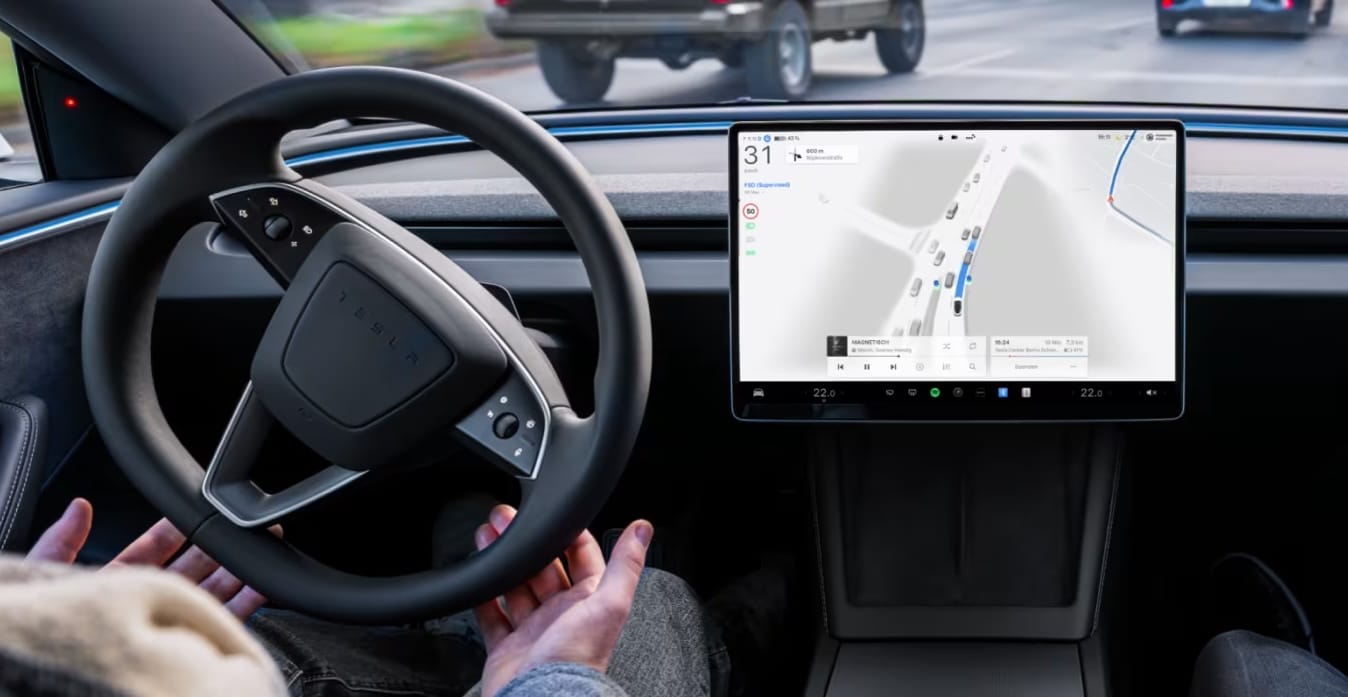
Key Takeaways
- Jim Fan praises Tesla’s FSD v14 as the first AI to pass the “Physical Turing Test.”
- Fan describes the initial experience with FSD v14 as “magical” but later becomes routine.
- He notes that removing FSD now would be painful, similar to giving up smartphones.
- The Physical Turing Test measures AI’s ability to perform real-world tasks rather than just text-based conversations.
- Elon Musk agrees, stating that FSD v14 shows maturing sentience and calls it the best “real-world AI.”
As Tesla continues to push the boundaries of autonomous driving technology, its Full Self-Driving (FSD) v14 has garnered significant attention not just from tech enthusiasts but also from leaders in the AI field. Among these is NVIDIA’s Director of Robotics, Jim Fan, who lauds Tesla’s latest AI advancement as the first to pass what he terms the “Physical Turing Test.” With Elon Musk also echoing these sentiments, it is clear that FSD v14 is a groundbreaking achievement in the realm of real-world artificial intelligence.
A ‘Magical’ Evolution with Real-World Impacts
Jim Fan, an esteemed researcher in embodied AI, shared his experiences with Tesla’s FSD v14 and likened it to the revolutionary impact of smartphones. Fan’s initial encounters with FSD v14 were described as “magical,” illustrating the surreal yet profound integration of AI into daily life. Over time, the presence of FSD becomes so routine that its absence is inconceivable, much like living without modern smartphones.
Understanding the Physical Turing Test
What is the Physical Turing Test?
The concept of the Turing Test was originally formulated by Alan Turing in 1950 as a metric to assess a machine’s ability to exhibit human-like behavior through text-based conversations. However, the Physical Turing Test, as introduced by Jim Fan, extends this notion beyond conversational ability to encompass the AI’s capability to execute complex, real-world tasks mirroring human intelligence. It challenges AI systems to demonstrate intelligence through physical actions in real-world settings.
FSD v14: A Leap Beyond Conversational AI
Tesla’s FSD v14 illustrates its capability not only in problem-solving but also in performing physical tasks with precision and autonomy. As an embodiment of the Physical Turing Test, FSD v14 showcases AI’s ability to seamlessly navigate real-world environments, bringing us closer to realizing the full potential of autonomous vehicles. This AI evolution from software-bound interactions to physical autonomy represents a significant leap forward, gaining acknowledgment even from Elon Musk, who pointed out the “maturing sentience” of Tesla’s AI.
Comparative Analysis: Tesla FSD v14 vs. Previous AI Versions
Advancements in AI Technology
- Advanced Neural Networks: FSD v14 employs cutting-edge neural networks for improved decision-making and path planning.
- Enhanced Sensor Integration: Utilizing an array of sensors, the latest version provides an enhanced understanding of environmental contexts.
- Real-Time Processing: FSD v14’s real-time data processing capabilities allow for responsive and adaptive driving strategies.
These enhancements mark a departure from previous iterations, with FSD v14 achieving a level of autonomy that brings it closer than ever to mirroring human-like decision-making.
Jim Fan’s Perspectives on AI and Robotics
Jim Fan’s endorsement of Tesla’s FSD v14 as a pioneer in passing the Physical Turing Test underscores his broader vision of AI and robotics. As a leader in the field, Fan advocates for AI systems that not only interpret data but also interact with the physical world in a meaningful and autonomous manner. His insights call for a deeper exploration of how AI can reshape our interaction with technology, making it an integral part of daily living.
The Road Ahead for Autonomous AI
The successful implementation of Tesla’s FSD v14 signifies an important milestone in autonomous technology. By effectively addressing real-world challenges through innovative AI systems, Tesla is not only redefining automotive experiences but also paving the way for future advancements in various fields of robotics and AI. As we look forward to more developments, the essence of the Physical Turing Test will continue to serve as a benchmark for AI’s journey towards intelligent autonomy.