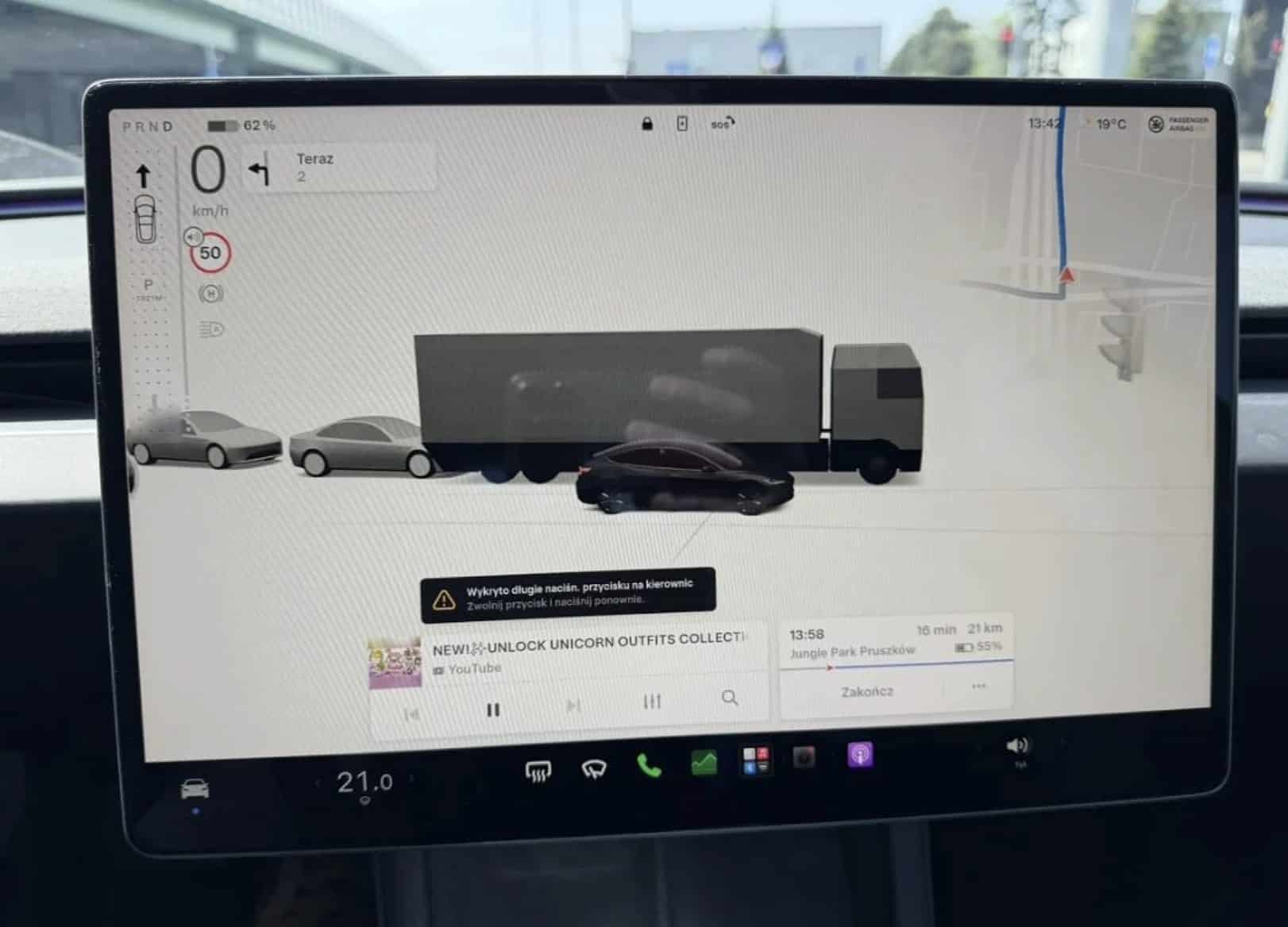
Tesla’s FSD Visualization Revolution: European Cab-Over Semis Arrive in 2026.14 – Paving the Way for Global Autonomy
Key Takeaways
- Tesla has integrated region-specific vehicle designs into FSD visualizations, starting with European-style cab-over semi-trucks in software update 2026.14.
- European Tesla owners now see accurate flat-fronted semis on their displays, alongside North American long-nose models, available to all without FSD subscription.
- Feature added in October but activated only after AI confirmed high-confidence detection, similar to horses and golf carts.
- Builds driver trust by matching local road realities, reducing anxiety and aiding EU regulatory approvals for FSD.
- Reflects Tesla’s data-driven approach, using global fleet data for regional nuances before global rollout.
- Signals serious intent for FSD international expansion, including robotaxis, with localization now core to the roadmap.
- Early European users report more intuitive visualizations, enhancing understanding of the car’s AI perception.
countless software updates have come and gone But the subtle genius of Tesla’s 2026.14 Spring Update has me genuinely excited. Buried among flashy features like the new Self-Driving App and enhanced weather maps is a game-changing tweak:region-specific vehicle visualizations, kicking off with European-style cab-over semi-trucks. This isn’t just a cosmetic upgrade—it’s a masterstroke in localization that signals Tesla’s unyielding march toward unsupervised FSD and robotaxis worldwide.❶ ❷
In this deep-dive blog post, we’ll unpack the update, explore why it matters for driver trust and regulations, analyze Tesla’s data-driven strategy, and speculate on the ripple effects for Europe’s burgeoning EV market and beyond. If you’re a Tesla owner in the EU—or anywhere plotting your next road trip—this is must-read intel.
The 2026.14 Spring Update: More Than Meets the Eye
Tesla’s software cadence is relentless, and 2026.14 (rolling out in waves as 2026.14.1, .2, and .3) packs a punch. Officially dubbed the “Spring Update,” it introduces:
- Self-Driving App (AI4): A one-tap hub for FSD subscriptions, tutorials, and progress tracking—perfect for newbies dipping their toes into autonomy. ❸
- Immersive Sound Upgrades and Rear Display Enhancements: Family road trips just got more entertaining.
- Weather Map Overhauls and Supercharger Pricing Filters: Practical aids for long-haul drivers, now with extended Dashcam downloads. ❹
- Sharper Vehicle Visuals: Higher-quality renders of your own Tesla on the center display, including crisp Model 3 and Y park scenes. ❺
But the star of the show for FSD watchers?Localized object detection and rendering. European Tesla owners are now spotting flat-fronted, cab-over semis—those boxy beasts ubiquitous on EU highways—in their Autopilot and FSD visualizations. North American long-nose rigs still appear where relevant, creating a seamless blend of global and local realities. Crucially, this feature isavailable to all drivers, FSD subscription or not, democratizing the experience.❶ ❻
Added in October 2025 but held back until the neural net hit “high-confidence” detection (much like recent additions for horses and golf carts), it’s a testament to Tesla’s cautious rollout philosophy.❶
Quick Comparison: Old vs. New Visuals
| Aspect | Pre-2026.14 (Generic) | 2026.14+ (Localized) |
|---|---|---|
| EU Semi-Trucks | Boxy, inaccurate long-nose proxies | Accurate cab-over designs with flat fronts |
| Detection Confidence | Medium (placeholders) | High (neural net validated) |
| Driver Impact | Potential confusion on highways | Intuitive, trust-building realism |
| Availability | FSD only in some cases | All Autopilot users |
This table highlights how Tesla is evolving from “good enough” to “glovebox-level precise.”
Why Region-Specific Visuals Are a Big Deal for Driver Trust
Imagine cruising the Autobahn behind a MAN or Volvo cab-over semi, only for your Tesla’s screen to render it as a generic American Peterbilt. Jarring, right? That’s the reality European drivers faced—until now. These visualizations aren’t fluff; they’re the driver’s “second set of eyes,” conveying the FSD neural net’s perception in real-time 3D.
- Reduces Cognitive Dissonance: When the screen matches the road, anxiety drops. Early EU users report feeling more “in sync” with the system, especially in mixed-traffic scenarios. ❼
- Enhances Situational Awareness: Color-coded trajectories, occupancy networks, and now hyper-local models make interventions rarer and safer.
- My Opinion: As someone who’s tested FSD across continents, this is psychology 101. Trust is the bottleneck for adoption—fix the UI, and humans hand over the wheel faster.
Pro Tip: If you’re on 2026.14, toggle to full-screen FSD view (new UI button spotted in EU demos) for the full effect.❽
Regulatory Tailwinds: Europe’s FSD Breakthrough
Timing is everything. This viz update lands amid massive EU progress:
- Netherlands Leads the Charge: RDW approved FSD Supervised in April 2026 after 18 months of testing—highways and city streets, under human supervision. ❾
- UNECE and Broader EU Path: Dutch approval under UN R-171 paves the way for summer rollouts. Sweden and others are queuing up. ❿
- Localization as Compliance Hack: Accurate road users? Regulators love it. Expect this to grease wheels for unsupervised FSD by 2027.
Tesla’s playbook: Collect fleet data stealthily, validate AI, then activate UIs. It’s why Europe skipped straight to V14-like capabilities without US-style beta drama.
Tesla’s Data Empire: Fueling Global Nuances
At its core, this is Tesla being Tesla—data-driven to the bone. With millions of miles from global fleets:
- Neural Net Training: EU Teslas log cab-over encounters, feeding the Occupancy Network for 3D world-building from pixels alone. ⓫
- High-Confidence Gates: No rollout until 99%+ accuracy, mirroring horses/golf carts.
- Scalability: Next? Japanese kei cars, Indian tuk-tuks, Australian road trains. The roadmap screams robotaxi readiness. ❷
Insight: Competitors like Waymo rely on geofencing; Tesla’s end-to-end vision scales borderlessly. This update proves localization is now “core to the roadmap.”⓬
Early User Feedback: Real Roads, Real Reactions
From forums to YouTube:
- “Finally, no more wonky trucks! Feels native now.” – EU Model Y owner. ⓭
- Videos show flawless rendering in Amsterdam traffic, turbo roundabouts conquered. ⓮
- Minor gripes: HW3 lag in dense viz, but V14.3 fixes incoming.
Advice for Owners:
- Update ASAP: Check for 2026.14.x via your app.
- Clean Cameras: Viz relies on pristine vision inputs.
- Test on Highways: Spot those semis and report via voice.
- Subscribe if Ready: EU FSD trials incoming—don’t sleep.
The Bigger Picture: Robotaxis, Expansion, and Advice for Investors/Owners
This isn’t isolated. Tesla’s global FSD map lights up: Netherlands green, Australia/NZ next, China iterating, Japan/Israel testing.⓯Robotaxis? Cab-over viz means Cybercabs navigating EU logistics hubs flawlessly.
My Prediction: By Q4 2026, 10+ EU countries live. Unsupervised by 2027 if data flows.
Investor Angle: FSD attach rate could hit 50% in Europe—billions unlocked. Buy the dip.
Owner Advice:
- Prep Your Ride: HW3/AI4 upgrade if needed; calibrate wheels.
- Ride-Alongs: Join EU demos for hands-on.
- Patience Pays: Localization = safer streets.
In conclusion, 2026.14’s cab-over semis are the canary in the coal mine for Tesla’s world domination. It’s not hype—it’s happening. Stay tuned for more breakdowns.
Related Coverage
- Tesla FSD v14.3.2: Game-Changing Smart Summon Upgrades and the Road to Unsupervised Autonomy
- Tesla’s Optimus Revolution: From Fremont Pilot to Giga Texas Mega-Factory – The Dawn of 10 Million Robots Per Year
- Tesla’s Autonomy Blitz: Miami Pop-Up, Robotaxi Surge, and Cybercab’s Road to Revolutionizing Mobility
- Tesla’s Mysterious Model Y L Prototype at Giga Texas: A Game-Changer for American Families on the Horizon?
- Tesla’s Cybercab Rolls Off the Line at Giga Texas: Ushering in the Autonomous Robotaxi Revolution
- Tesla Cybercab Ignites the Robotaxi Revolution: First Production Units Autonomously Roll Off Giga Texas Assembly Line