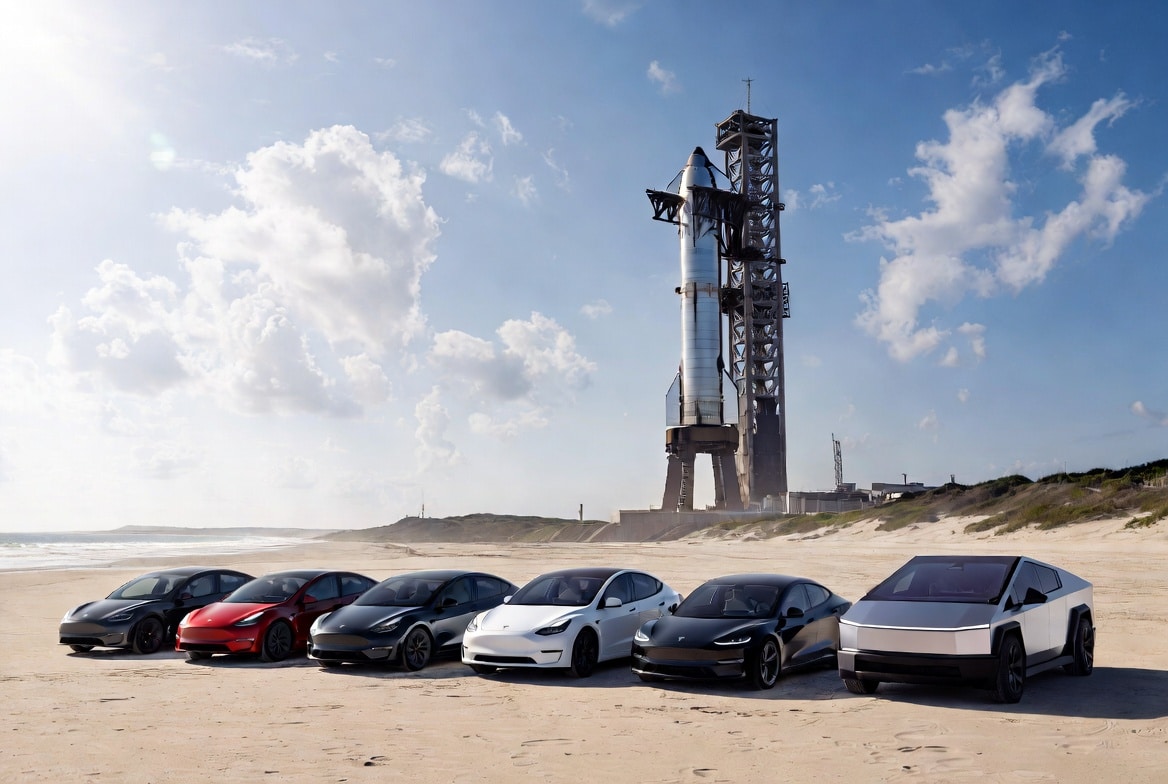
SpaceX’s Meteoric Shift: Rockets to AI Supremacy with xAI Merger, Orbital Supercomputers, and a $60B Cursor Gambit
Key Takeaways
- SpaceX, founded for routine spaceflight, is evolving like Tesla from hardware-focused to an AI powerhouse.
- Tesla shifted from EVs to AI/robotics via FSD, Optimus, Robotaxi, and Dojo; cars now just a platform for AI.
- February 2026: SpaceX acquired xAI in all-stock deal valuing combo at $1.25T ($1T SpaceX, $250B xAI), gaining Grok and training infra.
- New mission: Orbital data centers—solar-powered satellite supercomputers to bypass Earth’s power/cooling limits.
- SpaceX seeks approval for 1M such satellites; Starship enables mass launches with constant sunlight and passive cooling.
- Musk predicts space-based AI cheaper than ground in 2-3 years; Starlink V3 satellites to carry AI accelerators.
- Self-reinforcing loop: AI optimizes rockets/launches, rockets deploy more AI hardware.
- April 21, 2026: Option to buy Cursor AI coding tool for $60B, enhancing dev tools with Colossus clusters.
- Tesla-SpaceX parallels: Hardware funds AI; FSD chips like orbital inference; Optimus like lunar AI factories.
- SpaceX now AI firm with orbital moat; 2026 IPO pitched as ultimate AI infrastructure bet amid challenges like regs and light pollution.
In the ever-accelerating world of technology, few companies embody disruption like SpaceX. Founded in 2002 with the audacious goal of making humanity multi-planetary through routine spaceflight, SpaceX has long been synonymous with reusable rockets, Starship megalaunches, and Starlink’s global internet constellation. But as of April 2026, Elon Musk’s flagship enterprise is undergoing a profound transformation—mirroring Tesla’s pivot from electric vehicles to AI and robotics dominance. SpaceX is no longer just a space company; it’s morphing into the ultimate AI infrastructure juggernaut, leveraging orbital real estate to sidestep Earth’s terrestrial bottlenecks.❶
This evolution crystallized in February 2026 with the blockbuster acquisition of xAI, Musk’s own AI venture, in an all-stock deal that valued the combined entity at a staggering $1.25 trillion—SpaceX at $1 trillion and xAI at $250 billion.❷ ❸Fast-forward to April 21, and SpaceX secured an option to snap up AI coding powerhouse Cursor for $60 billion, signaling an aggressive push into developer tools powered by its Colossus superclusters.❹ ❺At the heart of this pivot? Orbital data centers: solar-powered satellite supercomputers designed to render ground-based AI training and inference obsolete. With Starship enabling mass deployments and Musk predicting space-based AI will be cheaper than Earth-bound alternatives in just 2-3 years, SpaceX is betting big on an “orbital moat.”❻ ❼
this isn’t hyperbole—it’s a self-reinforcing flywheel where AI optimizes rocketry, and rockets deploy exponentially more AI hardware. A 2026 IPO looms as the ultimate bet on AI infrastructure amid regulatory hurdles and astronomical backlash. Let’s dive deep.
The xAI Acquisition: Forging an AI-Rocket Colossus
On February 2, 2026, SpaceX announced it had acquired xAI in what Bloomberg dubbed the “biggest M&A transaction of all time.”❸Structured as a share exchange, xAI shareholders received 0.1433 SpaceX shares per xAI share, instantly folding Grok—the cheeky AI chatbot rivaling ChatGPT—into SpaceX’s arsenal alongside xAI’s cutting-edge training infrastructure.❽
Why now?Musk has long criticized Big Tech’s AI centralization, arguing for “maximum truth-seeking” via xAI. Merging it with SpaceX provides:
- Synergistic Compute: xAI’s models now train on SpaceX’s Dojo-like clusters, soon augmented by orbital hardware.
- Data Goldmine: Starlink’s petabytes of real-time global telemetry feed into Grok for rocket optimization and predictive analytics.
- Vertical Integration: From chip design (inspired by Tesla’s FSD) to launch, SpaceX controls the full AI stack.
In my view, this merger isn’t just financial wizardry—valuing xAI at 10x its prior rounds—it’s Musk consolidating his empire ahead of a public market debut. Post-merger memos hint at xAI co-founder departures and a re-org to streamline under SpaceX’s banner.❾Investors take note: SpaceX’s $1T valuation reflects not just launch contracts (NASA, DoD) but AI’s trillion-dollar TAM.
Orbital Data Centers: AI Compute Untethered from Earth
SpaceX’s crown jewel? A audacious plan forup to 1 million orbital data center satellites, filed with the FCC on January 30, 2026.❿These aren’t your grandma’s comms sats—they’re supercomputers in the sky, harnessing constant sunlight for solar power, radiative cooling in vacuum, and zero-gravity efficiency to bypass Earth’s power grid crises and water-cooling shortages.
Technical Breakdown
- Power & Scale: Each satellite boasts 100kW solar arrays dedicated to AI processors—think GPU/TPU equivalents for inference and training. ❻ Starlink V3 satellites, the size of a Boeing 737, pack 1Tbps downlink and laser-mesh interlinks for distributed computing. ⓫ ⓬
- Deployment: Starship launches ~60 V3 sats per flight, enabling rapid scaling. Orbits at 1,000km+ ensure perpetual daylight. ⓭
- Phased Rollout: SpaceX promises to “start small,” monitoring atmospheric reentry and light pollution impacts before mega-constellation status. ⓮
Musk’s bold claim: Orbital AI will undercut terrestrial costs by 2028-2029, as sats operate at ~$0.01/kWh equivalent vs. Earth’s skyrocketing energy bills.❼Imagine: Edge inference for autonomous drones, real-time climate modeling, or DoD simulations—all off-planet.
Challenges Ahead
Not everyone’s cheering. Astronomers warn a million sats (some 100m long) could “ruin astronomy” via light pollution and orbital clutter.⓯ ⓰Regulators scrutinize spectrum needs and Kessler syndrome risks. My advice to investors: These are surmountable—SpaceX’s FCC track record is stellar—but expect delays.
The Cursor Option: Supercharging AI Dev Tools
Hot off the presses on April 21, 2026: SpaceX inked a deal with Cursor, the AI coding sensation, granting anoption to acquire for $60B later this year or pay $10B for collaborative work. ❺ ⓱Cursor, valued far lower pre-deal, integrates with SpaceX’s Colossus clusters for hyper-accelerated software dev—think Grok-powered code gen for Starship autonomy.
Strategic Insight:This echoes Tesla’s Dojo bet. Cursor enhances SpaceX’s internal velocity while positioning it as an AI dev platform leader. Opinion: Exercise the option; $60B is a steal if orbital compute multiplies Cursor’s output 100x.
Tesla Parallels: Hardware as AI Platform
SpaceX’s arc mimics Tesla’s:
| Aspect | Tesla | SpaceX |
|---|---|---|
| Core Product | EVs → FSD/Optimus platform | Rockets → Orbital AI infra |
| AI Chips | HW4/Dojo for autonomy | Starlink V3 accelerators ⓲ |
| Flywheel | Cars collect data → Better AI | Launches deploy sats → More compute |
| Factories | Gigafactories → Optimus bots | Starship → Lunar/orbital fabs |
Cars are Tesla’s “compute nodes”; sats are SpaceX’s. Both fund AI via hardware cashflow.
The Ultimate Flywheel: AI Optimizes Rockets, Rockets Scale AI
- AI for Launches: Grok simulates trajectories, predicts failures—slashing R&D costs.
- Rockets for AI: Starship hauls Colossus-scale clusters to orbit/Luna.
- Exponential Growth: 1,000 Starships/year enable petascale orbital clusters. ⓳
This loop could 10x SpaceX’s valuation pre-IPO.
2026 IPO: The AI Infra Moonshot Bet
With IPO filings accelerating post-xAI merger, SpaceX pitches as “the ultimate AI infrastructure play.”⓴[21]Amid NVIDIA shortages and hyperscaler blackouts, orbital compute is the moat.Investment Advice:Allocate 5-10% portfolio; volatility high, but asymmetry favors bulls.
Risks to Watch:
- Regulatory Gridlock: FCC/ITU approvals for 1M sats.
- Competition: Blue Origin/Amazon eyeing orbits.
- Tech Hurdles: Radiation-hardened chips, latency.
SpaceX, the AI Firm in Disguise
SpaceX isn’t pivoting—it’s transcending. From routine flights to routine AI abundance, this is Musk’s masterstroke. As orbital data centers light up, we’ll witness compute liberation. Buckle up; the stars just got a lot smarter.
Related Coverage
- Elon Musk’s Unbreakable Control: Decoding SpaceX’s Dual-Class IPO Strategy and the $1.75 Trillion Launch
- Starship V3: SpaceX’s Bold Leap Toward Fully Reusable Orbital Dominance – Maiden Flight Looms on May 19
- SpaceX’s $60 Billion Gamble on Cursor AI: The Dawn of a Coding Superintelligence Era?
- SpaceXAI and Anthropic Strike Historic Deal: Full Access to Colossus 1 Supercluster Ushers in a New Era of AI Compute Abundance
- SpaceX’s Star Turn in the Golden Dome: How Elon Musk’s Empire is Shaping America’s Next-Gen Missile Shield