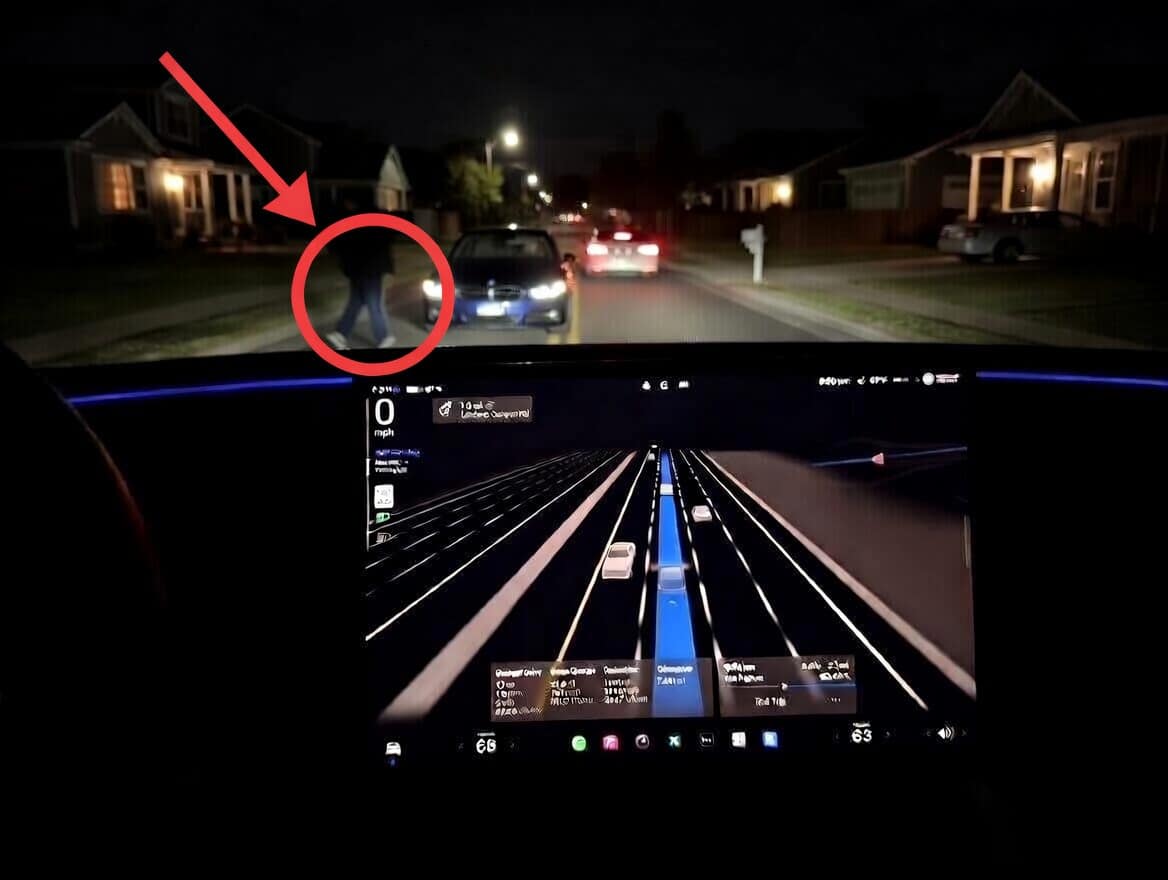
Tesla FSD vs. Human Drivers: The Jaw-Dropping Pedestrian Prediction That Exposes Why AI is Already Safer on Our Roads
Key Takeaways
- Tesla FSD anticipates pedestrian crossing by slowing down early, unlike oblivious BMW driver who forces pedestrian to retreat.
- FSD predicts intent from subtle cues like movement and trajectory, not just reacting to street entry.
- Powered by end-to-end neural network trained on billions of real-world miles for consistent human-like interpretation.
- Reddit r/TeslaFSD users criticize BMW driver for missing visible pedestrian, praising FSD’s proactive detection.
- Tesla data shows FSD (Supervised) is 54% safer than humans over billions of miles.
- Elon Musk predicts FSD v14 2-3x better than humans, v15 potentially 10x safer.
- Intent prediction vital for pedestrians; at 30 mph, 1 extra second of awareness prevents fatalities.
In a viral video that’s sparking heated debates across social media and Tesla forums, Full Self-Driving (FSD) Supervised demonstrates a level of foresight that leaves a human driver in a BMW looking dangerously oblivious. While the BMW barrels forward, forcing a pedestrian to retreat in panic, the Tesla slows down proactively—predicting the crosswalk intent from subtle cues like body language and trajectory. This isn’t just a “cool demo”; it’s a glimpse into why Tesla’s end-to-end neural networks are revolutionizing road safety, backed by billions of miles of real-world data.❶ ❷
I’ve seen skeptics dismiss FSD as “hype.” But with over 8 billion miles driven on FSD Supervised as of early 2026—and stats showing it’s up to 8-9 times safer than the average U.S. driver—the evidence is mounting. Let’s dive deep into this incident, the tech behind it, the latest safety data, and what v14 (and beyond) means for the future of driving.❸ ❹
The Viral Clip: FSD Anticipates, BMW Reacts Too Late
Picture this: A pedestrian stands at the curb, glancing toward traffic with telltale signs of intent—shoulder shift, foot placement, a subtle lean forward. Tesla’s FSD detects it early, easing off the throttle well before the crosswalk. Meanwhile, the BMW driver? Completely tuned out, phone in hand perhaps, plowing ahead until the pedestrian jumps back.
- Key Difference: FSD doesn’t wait for the pedestrian to step into the street. It predicts intent using vision-only inputs processed by neural nets trained on billions of miles. ❷
- Reddit Reactions: Users on r/TeslaFSD roasted the BMW driver, calling it a “perfect example of human distraction.” One top comment: “FSD saw the pedestrian’s vibe change 5 seconds earlier.” ❶
- Real-World Stakes: At 30 mph, that one extra second of prediction can mean the difference between a near-miss and a fatality. Pedestrian deaths hit record highs in the U.S.—over 7,500 in 2024—and intent prediction is the game-changer.
This isn’t isolated. Tesla’s fleet has logged countless similar scenarios, refining the AI to mimic (and exceed) human prudence.
The Brain Behind the Brilliance: End-to-End Neural Networks
Tesla ditched rule-based code years ago for end-to-end neural nets in FSD v12+, where cameras feed raw pixels straight to driving decisions. No hand-coded “if pedestrian steps out, then brake.”
How Pedestrian Intent Prediction Works
- Input Layer: 8+ cameras capture 360° video at 36Hz, spotting micro-movements like head turns or weight shifts.
- Neural Net Magic: Trained on 10M+ video clips from 8B+ FSD miles, it learns patterns humans miss—e.g., a phone-distracted pedestrian is 3x more likely to jaywalk.
- Output: Probabilistic predictions: “70% chance of crossing in 2 seconds.” Braking starts smoothly, not abruptly.
- Edge Over Humans: Fatigue-free, always vigilant. Humans miss 40% of subtle cues after 2 hours driving, per NHTSA studies.
My Take: This is AI’s superpower. Rule-based systems (like older ADAS in BMWs) reactafter the fact. FSD thinks ahead, turning roads into predictable chess games.❺
Crushing Safety Stats: FSD Supervised is Already 8x Safer Than Humans
Tesla’s Q1 2026 Vehicle Safety Report paints a clear picture. With 8.2 billion FSD miles:
| Metric | Miles per Crash | Improvement vs. U.S. Average (~670K miles/crash) |
|---|---|---|
| FSD Supervised | 5.3 million | 8x safer ❸ |
| Tesla w/ Active Safety (No FSD) | 2.2 million | 3x safer |
| Tesla No Autopilot | 1.2 million | Near average |
| Robotaxi (Unsupervised, Austin) | ~200K (NHTSA data) | Needs improvement ❻ |
- Trend: Gap widening—FSD was “54% safer” in 2024; now 8-9x in 2026. ❼
- Caveats: “Supervised” means attentive driver. Unsupervised robotaxis lag but are scaling fast.
- Elon’s Bold Claims: v14 is “2-3x better than humans”; v15 could hit 10x. With v14.3 in wide testing as of mid-March 2026, we’re close. ❽ ❶
Opinion: Critics cherry-pick robotaxi data, ignoring supervised FSD’s dominance. Bloomberg pegs it at 26x in some metrics. If you’re driving 20K miles/year, FSD could prevent 5-10 crashes lifetime.❾
FSD v14: Release Timeline, Improvements, and What’s Next
Rollout Status (March 2026)
- v14.2.x: Early access since late 2025; v14.2.2.5 notes focus on smoother interventions. ❿
- v14.3: Internal testing; wide release “in weeks” per Elon (as of Mar 19). ❽
- New Owners: 4-8 week wait post-delivery for v14. ⓫
Key v14 Upgrades
- Highway End-to-End Nets: Smoother merging, 10x parameter count. ❺
- Pedestrian/Jaywalker Handling: Hyper-accurate intent models, as seen in the BMW clip.
- Rain/Edge Cases: Users report “competent” performance in minor rain. ⓬
v15 Tease: 10x safety leap, unsupervised viability. Robotaxi event vibes incoming.
Why This Matters: Advice for Tesla Owners and Skeptics
For Owners:
- Enable FSD Supervised Daily: Stay vigilant, but data shows it’s safer than manual.
- Report Interventions: Every disengagement trains the fleet.
- HW3 vs. HW4: v14 shines on newer hardware; upgrades pending.
Broader Insights:
- Insurance Savings: Expect 20-50% drops as stats prove out.
- Urban Revolution: Cities with high pedestrian traffic (e.g., NYC) will benefit most.
- Competition Lags: Waymo’s geofenced; Cruise halted. Tesla’s scale wins.
My Prediction: By EOY 2026, unsupervised FSD in select cities. Humans? Stick to distractions—let AI handle the road.
Challenges Ahead: No Sugarcoating
- Unsupervised Hurdles: Austin robotaxis at 4-8x worse per NHTSA. ❻
- Regulatory Scrutiny: Safety metrics “deteriorating” claims from analysts—debunked by fleet data. ⓭
- Edge Cases: Rare phantom braking persists, but v14 minimizes.
Tesla’s not perfect, but the trajectory? Unmatched.
What do you think—ready to trust FSD fully? Drop comments below!