Tesla’s Folding V4 Superchargers: Revolutionizing EV Charging with 33% More Efficiency, 50% Faster Deployments, and the Dawn of a V3-Free Future
Key Takeaways
- Folding V4 Superchargers allow 33% more units per delivery truck.
- Deployment time reduced by 50%, speeding up installations.
- Overall installation costs cut by about 20%.
- Design folds for transit and unfolds on-site, easing logistics bottlenecks.
- Gigafactory New York ends V3 production after 15,000 units, fully shifting to V4.
- V4 cabinets: 500 kW/stall for cars, 1.2 MW for Semi, 2x stalls/cabinet, 3x power density.
- Max de Zegher emphasizes real-world throughput: peaks at 500 kW/post but <1 MW for 8 posts delivers max power 99% of time.
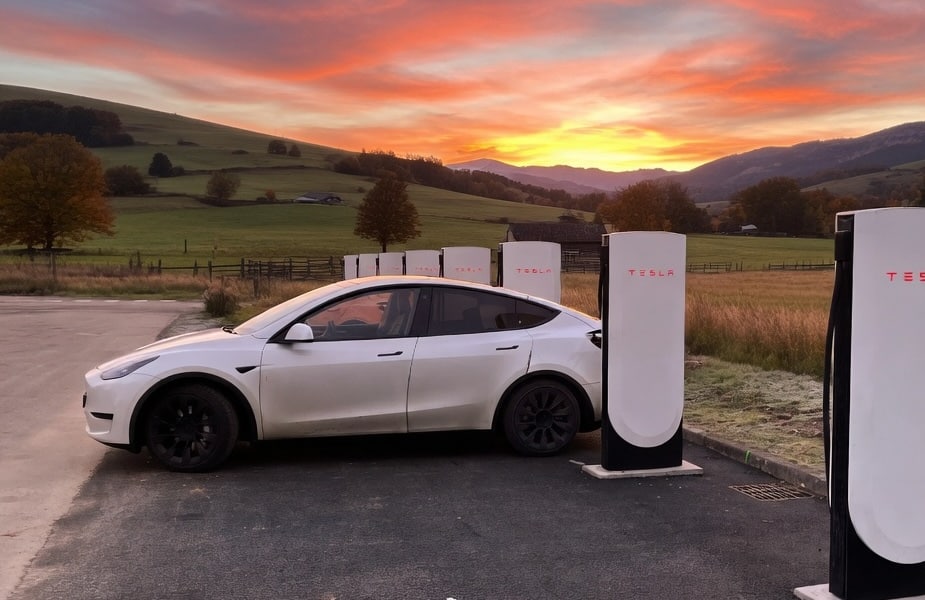
Tesla has always been at the forefront of electric vehicle infrastructure, and their latest innovation in the V4 Supercharger lineup is no exception. Imagine shipping 33% more charging units per delivery truck, slashing deployment times by half, and cutting installation costs by around 20%—all thanks to a clever folding design that transforms logistics from a bottleneck into a breeze.❶ ❷This isn’t just incremental improvement; it’s a seismic shift, especially as Gigafactory New York bids farewell to V3 production after churning out over 15,000 units, pivoting entirely to these next-gen V4 cabinets.❸ ❹In this deep-dive blog post, we’ll unpack the specs, logistics wizardry, real-world performance, and what it means for Tesla owners, Semi truckers, and the broader EV ecosystem. This reads as linchpin for mass EV adoption in 2026 and beyond
The Genius of the Folding V4 Design: Logistics Meets Innovation
At the heart of Tesla’s V4 Supercharger upgrade is thefolding unit design—a prefabricated system that collapses for transport and unfolds seamlessly on-site. This isn’t hype; it’s engineered efficiency.
- 33% More Units Per Truck: Traditional V3 setups limited trucks to about 12 posts. The folding V4 allows for 16 posts per load (two full units), doubling throughput per logistics run and easing supply chain strains. ❷ ❺
- 50% Faster Deployment: What once took days now happens in hours. Crews unfold, bolt down, and connect—minimal site prep required. This modular approach is like IKEA for charging stations: simple assembly, rapid scalability. ❶
- 20% Cost Reduction: Installation drops to under $40,000 per stall, a fraction of legacy systems. Lower labor, fewer trucks, and prefabrication mean massive savings passed on through denser networks. ❻
Why Logistics Matter More Than You Think
In my experience covering Tesla’s network growth, logistics have been the silent killer of expansion. Remote sites in the Midwest or mountains? Trucking costs and delays piled up. The folding V4 fixes this, enabling Tesla to flood highways with chargers faster than competitors like Electrify America or EVgo can react. Opinion: This is Tesla’s “Gigafactory moment” for infrastructure—scale begets dominance.
Visualizing the Fold: Before and After
| Aspect | V3 Supercharger | V4 Folding Unit |
|---|---|---|
| Truck Capacity | 12 posts | 16 posts (33% more) |
| Deployment Time | Baseline | 50% faster |
| Install Cost | Higher (~$225k/stall historical) | ~$40k/stall |
| Configurations | Fixed | 2x stalls/cabinet standard |
This table underscores the paradigm shift. Early pilots, like the Redwood City site, prove it works in the wild.❼
Gigafactory New York: Closing the V3 Chapter, Embracing V4 Supremacy
Tesla’s Buffalo Gigafactory (Gigafactory New York) has been a Supercharger powerhouse since 2019, producing over 15,000 V3 cabinets. But on March 16, 2026, the last V3 rolled off the line—a poignant milestone.❽Now, it’s V4-only, aligning U.S. production with global ambitions.
Key Production Insights:
- Volume Legacy: 15,000+ V3 units powered millions of charges, delivering 5 TWh annually network-wide.
- V4 Ramp-Up: Higher power density (3x V3) means fewer cabinets for more stalls. Expect output to surge as lines optimize. ❾
- U.S.-Centric Shift: All future power units stateside, reducing import dependencies and boosting jobs in New York. ❸
Advice for Investors and Enthusiasts
Watch Giga NY stock—it’s not just chargers; it’s a bet on Tesla’s energy empire. With V4 enabling Semi-scale charging (1.2 MW), this factory positions Tesla as the trucking electrification king.
V4 Technical Specs: Power, Density, and Versatility Unleashed
The V4 cabinet isn’t just foldable—it’s a beast under the hood.
- Power Output: 1.2 MW total capacity. Cars: Up to 500 kW/stall (615A at 1000V). Tesla Semi: Full 1.2 MW megawatt charging for rapid turnarounds. ❿ ⓫
- Stalls Per Cabinet: 2x V3 (8 vs. 4), with 3x power density for compact sites.
- Voltage Flexibility: 400-1000V support, liquid-cooled longer cables for all EVs (NACS/CCS1 adapters built-in). ⓬
- Efficiency: >96%, saving 100 GWh/year in waste heat network-wide.
Comparing V3 vs. V4 Side-by-Side
| Feature | V3 | V4 |
|---|---|---|
| Cabinet Power | 480-500 kW | 1.2 MW |
| Stalls/Cabinet | 4 | 8 |
| Max Stall Power | 250 kW | 500 kW (cars), 1.2 MW (Semi) |
| Power Density | Baseline | 3x |
| Cable | Standard | Longer, liquid-cooled |
Sources confirm V4 posts peak at 500 kW but shine in sustained delivery.⓭
Max de Zegher’s Real-World Throughput Wisdom
Tesla’s North American Charging Director, Max de Zegher, cuts through the specs noise: “Peaks at 500 kW/post, but <1 MW for 8 posts delivers max power 99% of the time.” This power-sharing ensures no bottlenecks—even at busy sites, you get near-peak speeds.⓮In practice, V4 guarantees 150 kW/post at full load, outpacing most rivals.⓯
Insight: De Zegher’s emphasis on throughput over raw peaks is spot-on. For road-trippers, this means 200+ miles in 15 minutes, reliably.
Benefits for EV Owners, Fleets, and the Planet
- Tesla Owners: Denser, faster stations mean less wait times. V4 sites like those opening in 2026 will upgrade existing V4 posts seamlessly. ⓰
- Non-Tesla EVs: Open network access with Magic Dock—Ford, Rivian, et al. benefit.
- Semi Revolution: 1.2 MW charging makes electric trucking viable now.
- Sustainability: 2% efficiency gains + solar integration (e.g., 11 MW arrays at new sites). ⓱
Opinion Piece: Accelerating Adoption
Tesla’s V4 isn’t just hardware—it’s ecosystem fuel. With costs down and speeds up, expect Superchargers every 50 miles on major U.S. interstates by 2027. Advice: If you’re buying a Cybertruck or Model Y, prioritize V4-heavy routes for future-proofing.
The Road Ahead: Deployment Roadmap and Challenges
2026 pilots (Redwood City, etc.) pave the way for mass rollout. Challenges? Grid upgrades, but Tesla’s lobbying and Megapack synergies help. Globally, Europe follows suit with V4 cabinets.⓲
Predictions:
- 50% of new sites V4 by EOY 2026.
- Semi fleet ramps with dedicated 1.2 MW lanes.
- Competitors scramble— Electrify America lags at 350 kW.
V4 – The Infrastructure Moonshot
Tesla’s folding V4 Superchargers mark the end of V3 growing pains and the birth of hyper-efficient charging. Faster, cheaper, greener—it’s everything EV advocates dreamed of. Stay tuned; this is just the charge-up.