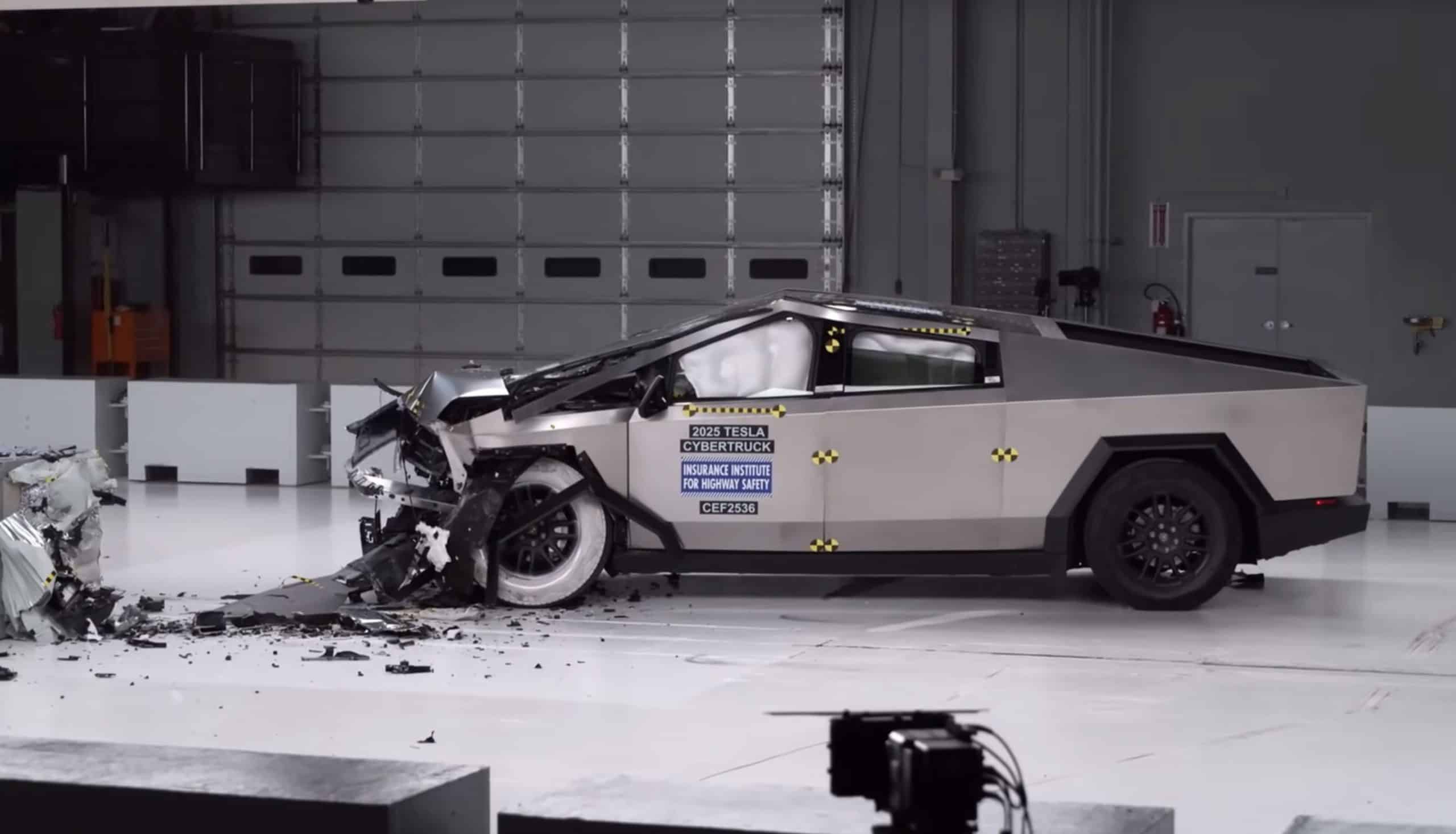
Tesla Cybertruck Shatters Expectations: The Only Pickup Truck with IIHS Top Safety Pick+ and NHTSA 5-Star Ratings
Key Takeaways
- Tesla Cybertruck earned the IIHS Top Safety Pick+ award, the highest honor, as the only U.S. pickup truck to achieve it.
- It also secured the only NHTSA Five-Star Safety rating among pickups, topping marks from both agencies.
- Achieved “Good” ratings in all IIHS crashworthiness categories (small overlap front, updated side, moderate overlap front) and crash avoidance/mitigation.
- “Good” ratings across most driver and pedestrian crash metrics; “Acceptable” for rear passenger chest.
- Pickups are popular in the U.S. for hauling/space; inherently safer due to size/weight, with Tesla’s edge in collision safety and repairability.
- Demand challenged by pricing, but $59,990 trim showed strong interest despite polarizing design.
In the rugged world of pickup trucks, where power, towing capacity, and off-road prowess often steal the spotlight, safety has emerged as the ultimate battleground. Enter the Tesla Cybertruck – the angular, stainless-steel behemoth that’s not just turning heads with its futuristic design but is also setting unprecedented safety benchmarks. As of late 2025, the 2025 Tesla Cybertruck (crew cab pickup, built after April 2025) has clinched the Insurance Institute for Highway Safety’s (IIHS) Top Safety Pick+ award – the organization’s highest accolade – making it the only U.S. large pickup truck to achieve this honor. ❶ It also boasts the sole NHTSA 5-Star Overall Safety Rating among pickups, solidifying its position as a safety leader in a segment dominated by traditional gas-guzzlers. ❷ ❸
This isn’t hype from Tesla fans; it’s backed by rigorous, independent testing from two of the most respected crash safety authorities. In this in-depth blog post, we’ll break down the ratings, compare the Cybertruck to rivals like the Ford F-150, Ram 1500, and Toyota Tundra, explore what these results mean for real-world safety, and offer advice for potential buyers. Buckle up – the Cybertruck isn’t just safe; it’s revolutionizing the pickup category.
Understanding the Gold Standards: IIHS Top Safety Pick+ and NHTSA 5-Stars
Before diving into specifics, let’s level-set on these awards.
IIHS Top Safety Pick+ Explained
The IIHS, a nonprofit dedicated to reducing crashes through research and engineering, awards Top Safety Pick (TSP) and Top Safety Pick+ (TSP+) annually to vehicles excelling in six key areas:
- Crashworthiness: Small overlap front (driver and passenger sides), updated moderate overlap front, updated side.
- Crash Avoidance: Front crash prevention (vehicle-to-vehicle and pedestrian).
- Headlights and other features like seat belt reminders and LATCH child seat anchors.
To earn TSP+, a vehicle needs “Good” ratings in all crash tests, “Superior” or “Advanced” front crash prevention, and top-tier headlights. For 2026 models, the Cybertruck (crew cab) is explicitly listed as TSP+ – the only large pickup to achieve it, with the Toyota Tundra crew cab earning just TSP. ❹ ❺
NHTSA 5-Star Safety Ratings
The National Highway Traffic Safety Administration (NHTSA) conducts government-mandated crash tests, rating vehicles from 1-5 stars (5 being best) across:
- Overall Vehicle Score
- Frontal Crash
- Side Crash
- Rollover
The Cybertruck earned a 5-Star Overall Rating, with perfect scores in side crashes and strong rollover resistance – a feat Tesla engineers showcased in behind-the-scenes videos. ❻
Cybertruck’s IIHS Ratings: A Deep Dive into “Good” Across the Board
The Cybertruck didn’t just pass; it aced every major category:
Crashworthiness Tests (All “Good” Ratings)
- Small Overlap Front (Driver & Passenger Sides): Simulates hitting a pole or narrow object at the corner. The Cybertruck’s exoskeleton and gigacastings maintained structural integrity, with low injury risks to head, neck, chest, and legs. ❶
- Updated Moderate Overlap Front: 40 mph offset crash focusing on rear passenger safety. “Good” overall, protecting the chest (notable since rear passenger chest was “Acceptable” in some metrics per initial reports). ❼
- Updated Side: Full-scale barrier at 37 mph. “Good” for driver and rear passenger, thanks to reinforced doors and side-impact beams. ❶
Crash Avoidance & Mitigation
- Vehicle-to-Vehicle Front Crash Prevention: “Superior” – avoided collisions at 25 mph and 37 mph, issuing warnings 2.2 seconds early. ❽
- Vehicle-to-Pedestrian: “Good” across day/night child/adult scenarios, leveraging low hood height (best for pedestrian safety) and advanced cameras/radar. ❾
- Headlights: Acceptable overall, with good visibility on curves and high-beam assist. ❶
Minor notes: Seat belt reminders “Marginal” due to short audible duration, LATCH anchors mixed (some too deep). ❿ Still, TSP+ secured.
NHTSA Results: 5-Stars Where It Counts Most
- Overall: 5 Stars
- Frontal Crash: 5 Stars overall (5 Driver, 4 Passenger in some configs – minor dip but still elite). ⓫
- Side Crash: 5 Stars across all measures – perfect. ⓬
- Rollover: Lowest probability among pickups, thanks to low center of gravity from the battery pack. ⓭
Tesla’s engineering – like the massive single-piece front casting – shone in these tests. ❻
Head-to-Head: How Cybertruck Stacks Up Against Pickup Rivals
Pickups are America’s best-seller for hauling and space, but safety lags due to size/weight trade-offs. Here’s the 2026 IIHS large pickups scorecard: ❺
| Truck Model (2026 Crew Cab) | IIHS TSP/TSP+ | Key Strengths | Weaknesses |
|---|---|---|---|
| Tesla Cybertruck | TSP+ | Good in all crashes, superior AEB | LATCH marginal |
| Toyota Tundra | TSP | Good moderate/side | Fewer “Superior” AEB ❹ |
| Ford F-150 | None | Optional small overlap | No award ❺ |
| Ram 1500 | None | Standard crashes | Headlights/front prevention gaps |
| Rivian R1T | None | Electric peer, good crashes | No TSP ❺ |
| Chevy Silverado 1500 | None | Moderate overlap good | Side not tested |
Insight: Cybertruck’s edge? Electric architecture enables better weight distribution, repairability, and active safety like Full Self-Driving (Supervised). ❾ Traditional trucks struggle with higher hoods hurting pedestrian scores.
Why This Matters: Size, Design, and Real-World Safety
Pickups are inherently safer in collisions due to mass (they win “Darwin awards” against cars), but intra-pickup crashes and pedestrians are risks. Cybertruck’s low hood correlates to top pedestrian safety. ⓮ Its polarizing exoskeleton? Proven tough – no “death machine.” ❸
Opinion: Critics dismissed the design, but data proves Tesla’s simulation-first approach works. Demand persists despite pricing ($60K base shows interest). ⓯
Buyer Advice: Is the Cybertruck Right for You?
- Prioritize Safety: If family hauling, Cybertruck’s TSP+ and 5-Stars make it unbeatable.
- Check Build Date: Post-April 2025 for full ratings.
- Test Active Safety: FSD adds layers beyond passive protection.
- Compare Costs: EVs cheaper long-term; repairability high despite stainless steel.
- Alternatives: Tundra for TSP, but no +.
Pro Tip: Use IIHS/NHTSA sites for updates – safety evolves.
Final Thoughts: A Safety Revolution on Wheels
The Cybertruck’s “absolutely insane” safety sweep – per Teslarati – cements Tesla’s lead in EVs and trucks. ❾ In a market craving capability and protection, it’s the benchmark. Will rivals catch up? Time will tell, but for now, the future is armored, electric, and safer than ever.
What do you think – game-changer or gimmick? Drop a comment!