Tesla’s AI5 Chip Blitz: Elon Musk Accelerates to 9-Month Cycles, Eyes World’s Top AI Silicon Empire
Key Takeaways
- Tesla’s AI5 chip design is nearly complete, with AI6 already in early development.
- Future chips (AI7, AI8, AI9+) targeting a rapid 9-month design cycle for fast iteration.
- Tesla’s in-house chips poised to become the world’s highest-volume AI processors.
- Elon Musk’s X post serves as a recruiting call for AI and chip engineers.
- Community member Herbert Ong emphasizes faster chip cycles enable quicker AI learning and competitive edge.
- Samsung (2nm) and TSMC (3nm) manufacturing AI5; both versions to perform identically, succeeding AI4 for FSD and Optimus.
In a bombshell update straight from Elon Musk’s X feed, Tesla’s AI5 chip—the powerhouse set to supercharge Full Self-Driving (FSD) and Optimus robots—is “almost done” in design, with AI6 already kicking off early development.[1] This isn’t just incremental progress; it’s a declaration of war on complacency in the AI hardware race. Musk is gunning for a relentless 9-month design cycle for AI7, AI8, AI9, and beyond, positioning Tesla’s in-house silicon as the highest-volume AI processors on the planet.[2] As a blogger who’s tracked Tesla’s silicon journey from HW3 to AI4, this feels like the inflection point where Tesla doesn’t just catch up—it laps the field.
Breaking Down Musk’s Latest X Bombshell
Elon Musk dropped this gem amid a recruiting rally cry: “Necessity is the mother of invention. The @Tesla_AI team is epicly fast. Our AI5 chip design is almost done, and AI6 is in early stages… aiming for a 9-month design cycle.”[3] It’s classic Musk—part tech flex, part talent poach. He’s not subtle: Tesla needs more engineers to sustain this blistering pace, and he’s betting the farm on in-house chips to fuel autonomy at scale.
Tesla community heavyweight Herbert Ong nailed the stakes: Faster chip cycles mean quicker AI learning loops, rapid iterations, and a “compounding advantage” that leaves rivals choking on dust.[4] Ong’s right—it’s not just hardware; it’s a flywheel for data-driven dominance.
AI5 vs. AI4: A 40x Performance Quantum Leap
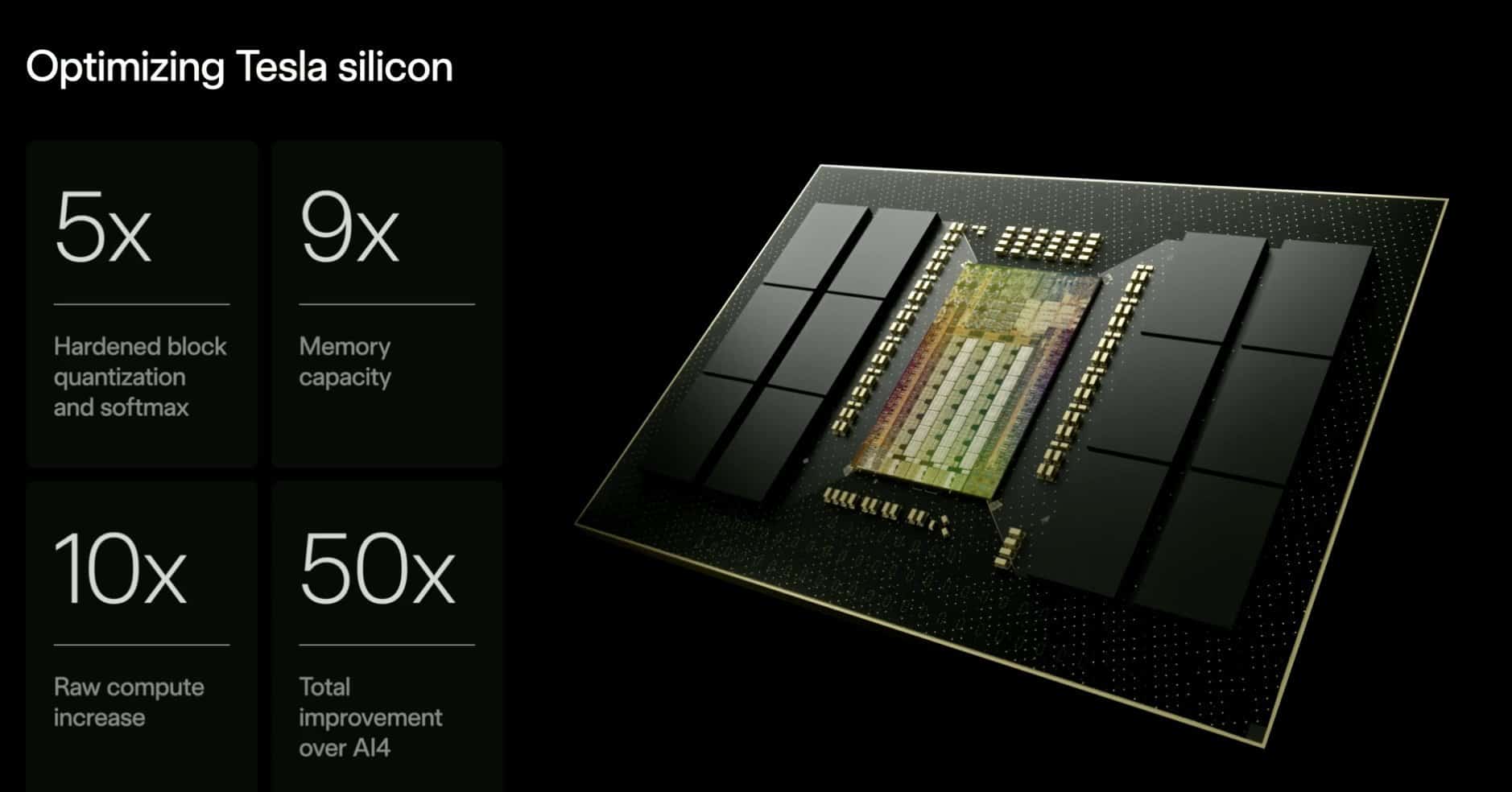
Let’s get nerdy. Current AI4 (ex-HW4) powers today’s Cybertrucks and Highland Model 3/Y, delivering solid inference for FSD v14. But AI5? Elon claims up to 40x better performance in key metrics—think 8x raw compute, 9x more memory, and streamlined code efficiency yielding 5x gains.[5][6]
Here’s a quick spec showdown:
| Feature | AI4 (Current) | AI5 (Upcoming) |
|---|---|---|
| Process Node | ~5-7nm equivalents | TSMC 3nm / Samsung 2nm |
| Compute | Baseline | 8x raw power[6] |
| Peak Perf. | ~1,000-2,000 TOPS (est.) | Up to 40x inference tasks[7] |
| Power Draw | ~100-150W | 200-250W (higher throughput)[8] |
| Memory | Standard DDR/LPDDR | 9x more, possibly cheaper RAM vs. HBM[9] |
This isn’t hype—it’s engineered for edge AI inference, where Tesla’s video-trained models shine. AI5 will slash FSD compute costs 10x cheaper than Nvidia equivalents, per Musk, unlocking robotaxi fleets and Optimus armies at margins Big Tech can only dream of.[7]
Pro Tip for Investors/Engineers: If you’re eyeing TSLA stock, watch Q1 2026 earnings for AI5 engineering samples. Production ramps in 2027, but early wins could juice FSD adoption.[10]
Foundry Firepower: Samsung and TSMC’s High-Stakes Duel
Tesla’s diversifying bets smartly. AI5 splits production:
- TSMC (3nm N3P): Arizona fab, mass prod underway for high-volume FSD chips (~2500 TOPS potential).[11]
- Samsung (2nm): Taylor, Texas plant—Musk praises their “advanced equipment.” Trial runs confirm viability.[12][13]
Musk insists both versions perform identically despite process diffs—different foundries, same silicon magic.[14] Samsung’s ramp-up includes hiring sprees for U.S. production, hedging geopolitical risks while chasing sub-3nm supremacy (only TSMC, Samsung, Intel play here).[15]
This dual-sourcing? Genius risk mitigation. TSMC’s yield king status pairs with Samsung’s aggressive nodes, ensuring Tesla hits “highest-volume” status without single-point failures.
Why This Matters for Global Supply Chains
- U.S. Focus: Texas/Arizona fabs scream onshoring amid CHIPS Act subsidies.
- Edge Over Nvidia/AMD: Tesla’s custom inference silicon (vs. training-focused GPUs) targets the 90% of AI workloads happening in vehicles/robots.[16]
The Grand Roadmap: AI6, AI7, and the 9-Month Sprint
AI5 unlocks the door; the real party starts post-2027:
- AI6: Early design now, Samsung Texas fab confirmed. Focus: Scaled inference for data centers + robots.[9]
- AI7-AI9+: 9-month cycles = ~3x faster than industry norms. Mixed-precision architecture for edge efficiency.[17]
- Volume King: Billions of miles of FSD data + Optimus fleets = unmatched inference scale.
My Take: This cadence echoes Moore’s Law on steroids. Competitors like Waymo (laser-dependent) or Cruise can’t match Tesla’s video-AI flywheel. Advice to startups: Partner with Tesla’s ecosystem or get iterated out.
Recruiting Wars and Competitive Moats
Musk’s post doubles as a siren call: “Join Tesla AI/chip teams!” With Jim Keller’s influence lingering, Tesla’s attracting top silicon talent.[18] Herbert Ong’s insight? Chip speed = learning speed = moat depth.
Talent Advice: If you’re a chip designer, Tesla’s 9-month cycles beat FAANG bureaucracy. Apply now—AI5 tape-out is imminent.
Broader Implications: Tesla as AI Powerhouse
- FSD/Optimus Synergy: AI5 powers unsupervised FSD v13+ and humanoid bots scaling to factories.
- Dojo Pivot: Less supercomputer, more inference chips—smarter capex.[17]
- Economic Edge: 40x perf at 10x lower cost? Robotaxi margins could hit 70%+.
Investor Insight: TSLA’s P/E looks frothy, but AI silicon unlocks $1T+ TAM. Buy dips if Cybercab delays, but this roadmap screams upside.
Peering into 2026-2027: What to Watch
- Q1 2026: AI5 samples, FSD v15 benchmarks.
- 2027: High-volume prod, Optimus Gen3.
- Risks: Yield issues at 2nm? Geopolitics?
Tesla’s not building cars—it’s forging the AI inference backbone. Buckle up; the silicon revolution accelerates.