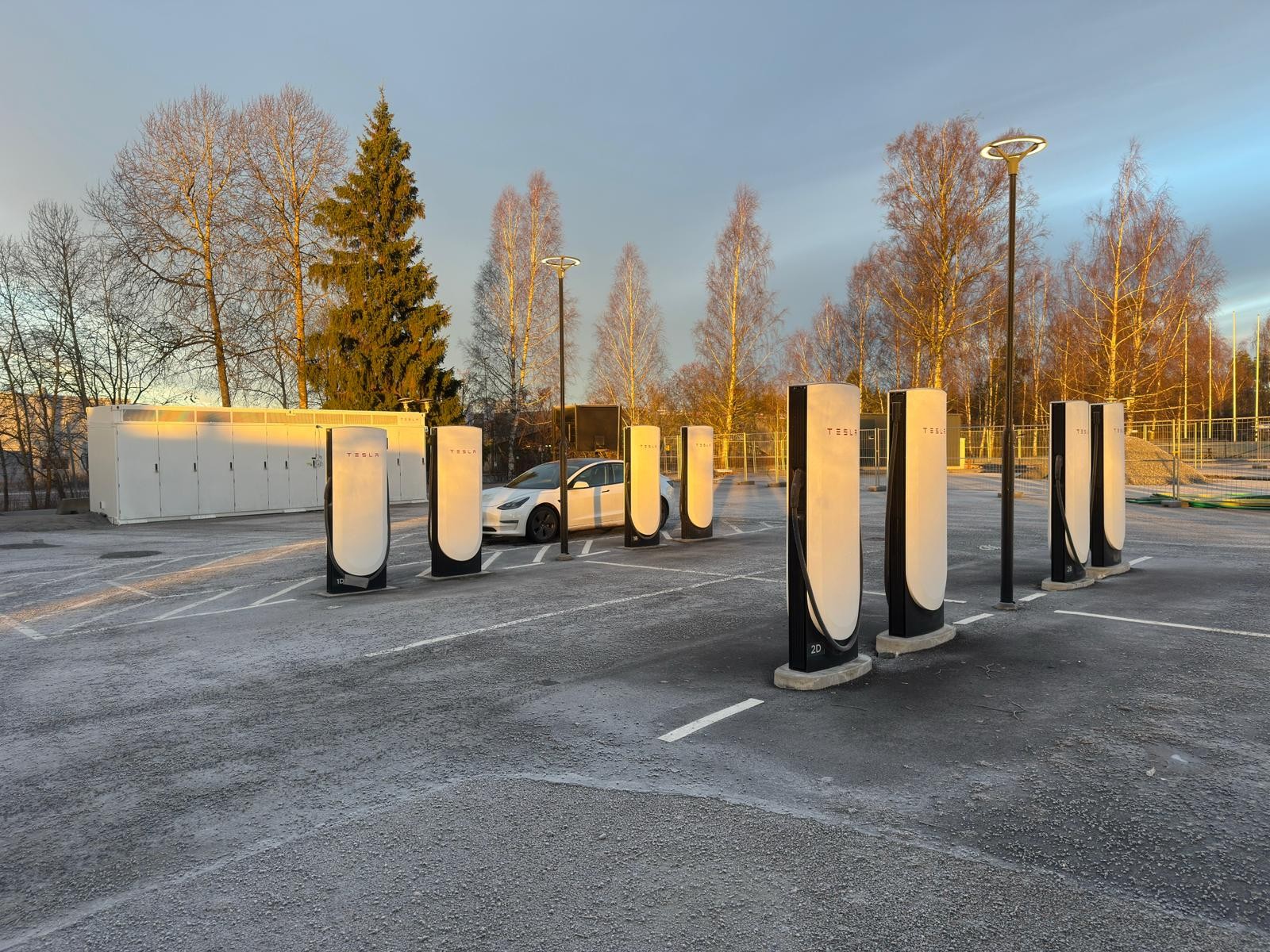
Tesla’s Megapack Masterstroke: Sidestepping Sweden’s Union Blockade to Launch a Game-Changing Supercharger
Key Takeaways
- Tesla Sweden launched a Supercharger in Arlandastad using Megapack batteries to bypass unions’ grid connection blockade.
- Seko union has blocked new electrical connections for Tesla Superchargers, making traditional openings nearly impossible.
- Previous sites in Malmö and Södertälje opened via grid operators E.ON and Telge Nät, later deemed errors.
- Arlandastad site has 8 of 40 planned stalls live, recharged indirectly via nearby companies’ grid access.
- Peter Esse notes the Megapack workaround isn’t easily replicable elsewhere due to unique location factors.
- Unions’ blockades devastate Tesla’s charging operations but minimally impact car sales, per Esse; people charge at home.
- Superchargers serve non-Tesla EVs too, highlighting the blockade’s broader effects.
corporate-union showdowns are a recurring pattern here. But Tesla Sweden’s latest move—deploying a Megapack battery system to power a new Supercharger station in Arlandastad despite a union-led grid blockade—is nothing short of brilliant engineering improvisation.[1][2]This isn’t just a workaround; it’s a statement on resilience, innovation, and the future of EV infrastructure in union-stronghold markets like Sweden. In this deep dive, we’ll unpack the backstory, the tech, the impacts, and what it means for Tesla owners, EV drivers, and the broader green energy transition.
The Tesla-Sweden Union War: A Timeline of Escalation
Sweden’s labor landscape is legendary for its collective bargaining power, where unions like IF Metall and Seko wield significant influence. Tesla’s saga began in late 2023 when IF Metall launched a sympathy strike against Tesla’s refusal to sign a collective agreement with service workers.[3]What started as a service center blockade snowballed:
- Ports and Deliveries Blocked: By November 2023, Transport union halted Tesla imports at key ports.[4]
- License Plates Halted: PostNord, pressured by unions, stopped delivering plates, upheld by courts in 2024.[5]
- Supercharger Siege: In early 2024, Seko (electricians’ union) joined, blocking new grid connections for Superchargers, rendering expansions “nearly impossible.”[1]
Fast-forward to 2025: Despite partial wins—like Vision union withdrawing a “potentially illegal” blockade on a Kalmar service center in December—the core disputes rage on.[6]Seko issued fresh notices as recently as October 2025.[7]As of January 2026, the blockade persists, freezing grid access and causing weekend charging chaos.[8]
Key Players:
- IF Metall: Leads the charge for collective agreements.
- Seko: Targets electrical infrastructure, crippling Superchargers.[9]
- Tesla: Stands firm on direct employee contracts, no unions.
This isn’t anti-EV activism; it’s pro-labor tradition clashing with Tesla’s non-union model.
The Supercharger Blockade: A Broader EV Pain Point
Seko’s blockade specifically halts new electrical hookups, leaving planned sites dormant. Past slip-ups—like E.ON and Telge Nät accidentally activating Malmö and Södertälje stations—were quickly reversed as “errors.”[1]The result? Long queues at existing chargers, hurting not just Tesla butallCCS-compatible EVs.[10]
In January 2025, unused Superchargers exacerbated weekend gridlock.[11]Tesla Director Gustav Landkvist publicly blamed unions for the “charging chaos.”[8]Ironically, this strengthens competitors like IONITY or Circle K, but slows Sweden’s EV adoption.
Tesla’s Megapack Genius: Powering Arlandastad Without the Grid
Enter the hero: Tesla’s Megapack, a massive, modular battery system designed for utility-scale storage. Just before Christmas 2025, Tesla flipped the switch on Arlandastad (near Stockholm Airport) withon-site Megapacks, bypassing Seko’s grip entirely.[1][12]
How It Works:
- No Direct Grid Tie: Batteries store power, charged indirectly via neighboring businesses with existing grid access (private deals).[1]
- Phased Rollout: 8 of 40 stalls live now; scalable as batteries recharge.[13]
- Open to All: CCS-compatible for non-Tesla EVs, at Cederströms Slinga 80.[14]
Swedish journalist Peter Esse calls it “impressive” but site-specific—Arlandastad’s industrial neighbors enable recharging, unlike remote areas.[1][2]Still, it’s a proof-of-concept for off-grid EV hubs.
Sales Impact: Blockades Bite Charging, Not Car Sales (Much)
Unions hoped to tank Tesla sales, but data tells a nuanced story:
| Period | Tesla Sweden Registrations | YoY Change | Notes |
|---|---|---|---|
| 2024 Full Year | Record high (~20,000+ est.) | N/A | Blockades ongoing[1] |
| May 2025 | ~200 units | -80% | Sharp drop[15] |
| July 2025 | Plunge | -85.8% | YTD -63%[16] |
| Dec 2025 YTD | ~1/3 of 2024 | -70% | Unions + market slowdown[17] |
| Dec 2025 | 821 units | -71% | Continued decline[18] |
Esse argues: Blockades devastatecharging opsbut sales dip from 2024 peak; Swedes charge at home.[1]Market factors (competition, economy) loom larger.
Expert Voice: Peter Esse’s Balanced Take
Peter Esse, a top Swedish EV YouTuber, provides clarity: Megapack works here due to “unique” logistics, but replication is tough. Unions fail to dent sales meaningfully—drivers adapt.[1]His analysis underscores Tesla’s adaptability.
Future Outlook: Scalable Solutions and Policy Shifts?
- For Tesla: Megapacks could proliferate in blocaded markets; pair with solar for true independence.
- EV Drivers’ Advice:
- Monitor Tesla app for Arlandastad updates.
- Diversify: Use home Level 2 chargers (80% of sessions).
- Advocate: Push for neutral infrastructure policies.
- Europe-Wide: Norway’s union-free EV boom contrasts Sweden; expect copycat tactics elsewhere.[19]
IF Metall paused strikes in August 2025 after 600 days, hinting at fatigue.[3]Courts may intervene more.
Innovation Trumps Entrenched Power
Tesla’s Megapack play exemplifies Elon Musk’s playbook: When blocked, innovate around. Unions protect workers but risk stalling EV progress—Sweden’s 50%+ EV market share can’t afford infrastructure lags. For investors: Bullish signal on Tesla Energy. For buyers: Sweden remains viable; home charging reigns supreme.
This feud tests the Swedish model. Will Tesla bend, or will unions adapt? Stay tuned—I’ll update as 2026 unfolds.