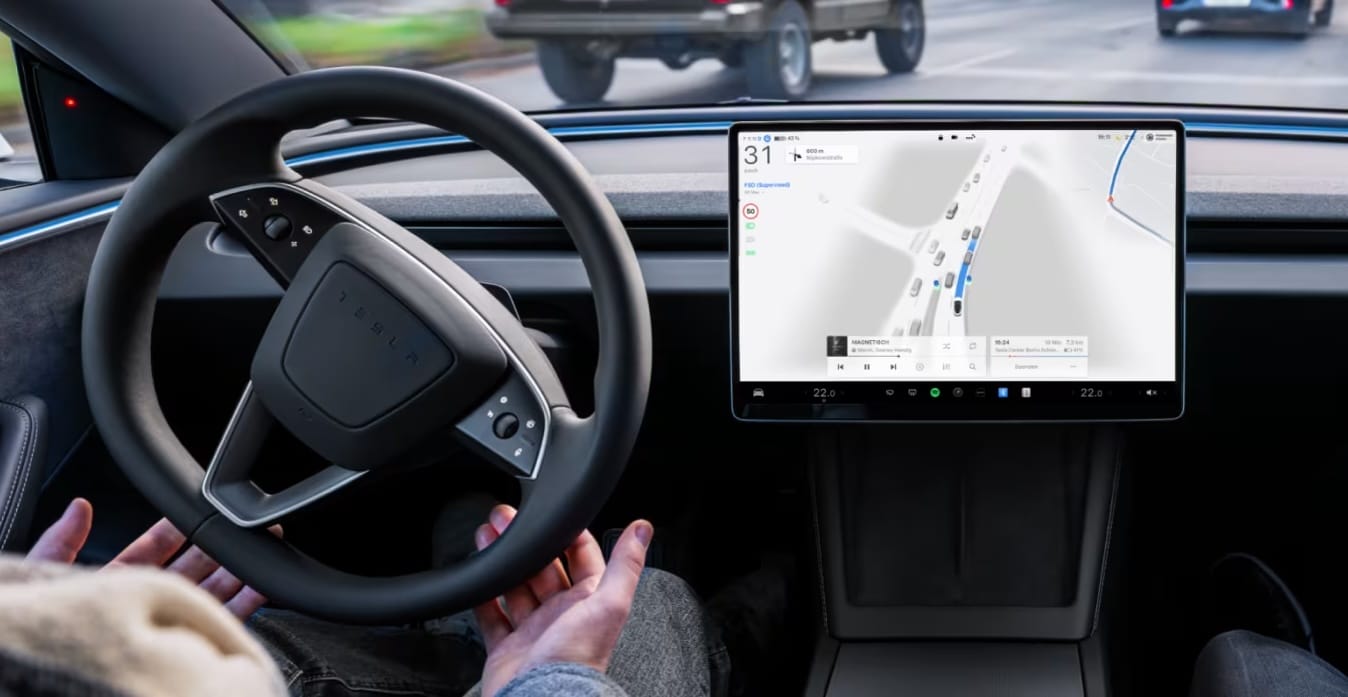
Tesla VP Lars Moravy’s Bold Senate Testimony: Why America Needs a Federal AV Framework Now
Key Takeaways
- Lars Moravy testified before the U.S. Senate Commerce Committee advocating for a federal framework on autonomous vehicles to replace patchwork state rules.
- This framework would reward innovation, boost U.S. manufacturing, and prevent falling behind rivals like China.
- Current state regulations slow AV progress by forcing companies to battle local legislators.
- Tesla’s Full Self-Driving (FSD) averages 5.1 million miles before a major collision, vs. human average of 699,000 miles.
- NHTSA data shows 94% of crashes due to human error, highlighting AV potential to reduce fatalities.
- Moravy addressed cybersecurity skeptics: No remote takeovers of Tesla vehicles due to core-embedded security and dual cryptographic signatures.
- Tesla commits to inclusive mobility via future Robotaxis for disabled, elderly, and blind individuals.
- Testimony emphasized geopolitical urgency and global benefits of U.S. AV leadership.
In a pivotal moment for the autonomous vehicle (AV) industry, Tesla’s Vice President of Vehicle Engineering, Lars Moravy, took the stage before the U.S. Senate Commerce Committee on February 4, 2026. During the hearing titled “Hit the Road, Mac: The Future of Self-Driving Cars,” chaired by Senator Ted Cruz, Moravy made a compelling case for a unified federal framework to govern AV development and deployment.u2776 u2777Joined by witnesses from Waymo and the Autonomous Vehicle Industry Association, his testimony wasn’t just a pleau2014it was a wake-up call. With China racing ahead in AV tech, outdated state-by-state regulations are stifling U.S. innovation, safety advancements, and economic leadership. As a blogger who’s followed Tesla’s AV journey since the early Autopilot days, This reads as defining crossroads Let’s dive deep into the key points, backed by data, and explore what it means for the future of mobility.
The Regulatory Patchwork: A Major Roadblock to Progress
Moravy didn’t mince words: the current “patchwork of state-by-state rules” is slowing AV progress and forcing companies like Tesla to wage endless battles with local legislators just to test in controlled areas.u2778 u2779Imagine trying to roll out a national product while navigating 50 different sets of rulesu2014some states like California and Texas are AV-friendly, but others lag with stringent permitting, insurance mandates, and operational restrictions.u277a
Federal vs. State: A Clear Imbalance
- Federal Role: The National Highway Traffic Safety Administration (NHTSA) sets minimum safety standards, but lacks comprehensive AV-specific laws. No unified federal framework exists yet, leaving a vacuum.u00a0u277b
- State Dominance: Over 40 states have enacted AV legislation, covering testing, deployment, and safety reporting. This leads to inconsistenciesu2014e.g., Arizona allows broad testing, while New York imposes heavy data-sharing requirements.u00a0u277c
- The Cost of Fragmentation: Companies spend millions on compliance, delaying scaling. Moravy argued a federal framework would standardize rules, reward safety data like Tesla’s, and streamline approvals.
My opinion? Congress must act swiftly. A federal preemption model, similar to aviation regs, could harmonize standards without stifling states’ rights on local ops. The Autonomous Vehicle Industry Association echoed this in their 2025 policy push.u277d
Tesla’s Full Self-Driving (FSD): Safety Stats That Speak Volumes
At the heart of Moravy’s pitch was Tesla’s real-world data. Tesla vehicles with FSD engaged average5.1 million milesbefore a major collisionu2014over7x saferthan the human average of 699,000 miles. This aligns with Tesla’s latest Vehicle Safety Report, which compares FSD (Supervised) collision rates to manual driving, showing consistent outperformance.u277e u277f
Breaking Down the Numbers
| Metric | Tesla FSD (Supervised) | Human Drivers (US Avg) | Improvement Factor |
|---|---|---|---|
| Miles per Major Collision | 5.1 million | 699,000 | 7.3x safer u24eb |
| Miles per Crash (Q2 2025) | Varies by engagement | 963,000 (no Autopilot) | Up to 10x on highways u24ec |
| Fatality Rate Comparison | Lower than US avg of 1 per 94M miles | Baseline | 38% safer with Autopilot u24ed |
Moravy reinforced this with NHTSA’s longstanding stat:94% of crashes stem from human erroru2014distraction, impairment, or poor decisions.u24ee u24efAVs like FSD could slash fatalities (over 40,000 annually in the US) by addressing this core issue.
Caveat from Recent Data: While impressive, NHTSA’s latest on Tesla robotaxis shows higher incident rates in early unsupervised trialsu2014up to 9x human rates in some metrics.u24f0This underscores the need for federal oversight to validate and scale safely, not hinder it.
Insight: Investors and policymakers should demand transparent, telematics-based reporting. Tesla leads here with billions of miles of datau2014others like Waymo must catch up.
Cybersecurity: Dispelling the Myths
Skeptics raised hacking fears during the hearing, but Moravy fired back: “No one has ever been able to take over control of our vehicles.” Tesla’s architecture features acore-embedded central layer inaccessible from external connections and dual cryptographic signaturesfrom two individuals.u24f1
Tesla’s Multi-Layered Defenses
- Sentry Mode & Cabin Camera: Monitors surroundings and interiors.u00a0u24f1
- PIN to Drive & Intrusion Sensors: Prevents unauthorized access.
- OTA Updates & Encryption: Regular patches and secure server comms.u00a0u24f2
- Bug Bounty Program: Rewards ethical hackersu2014no warranty voids for good-faith research.u00a0u24f3
Vulnerabilities exist (e.g., 2024 TPMS flaw), but none have enabled remote control takeover.u24f4A federal framework could mandate such standards industry-wide.
Advice for buyers: Enable all security features and use strong app credentials. Tesla’s edge here builds trust for Robotaxi fleets.
Inclusive Mobility: AVs for All
Moravy highlighted Tesla’s commitment: “We are committed with our future products and Robotaxis to provide accessible transportation to everyone.” This targets the disabled, elderly, and blindu2014groups underserved by current transit.
- Robotaxi Potential: Unsupervised fleets could offer 24/7, affordable rides.
- Global Impact: Beyond U.S., AVs could transform mobility in developing regions.
Opinion: This is AVs’ moral imperative. Pair it with federal incentives for accessibility features.
Geopolitical Urgency: Don’t Let China Win the Race
Moravy warned that without updates, the U.S. risks falling behind China in AV leadership and manufacturing. Testimony blended safety proofs with a call to “maintain its position in global technological development.”
China’s Baidu Apollo and Pony.ai are deploying at scaleu2014U.S. must match via federal innovation rewards.
analysis: Action Items for Congress and Industry
Moravy’s testimony is spot-on.Pros: Data-driven, visionary.Cons: Needs broader industry buy-in (Waymo pushed back on some points).[21]
Advice:
- For Lawmakers: Pass the SELF DRIVE Act revivalu2014federal preemption with safety baselines.
- For Tesla/Competitors: Share anonymized data via NHTSA portal.
- For Consumers: Advocate locally, test FSD responsibly.
- Investors: Bet on AV enablers like compute chips.
The future? By 2030, Robotaxis could add $10T to global GDP. But only with federal green lights.
What do you thinku2014federal now or state evolution? Comment below!
“