SpaceX static fires Falcon 9 rocket for Italian radar satellite launch
SpaceX has successfully tested a Falcon 9 rocket tasked with launching Italy’s CSG-2 Earth observation satellite as early as 6:11 pm EST (23:11 UTC), Thursday, January 27th.
For any European Space Agency (ESA) member state, launching a spacecraft on a non-European rocket is a rarity. Because the Ariane and Vega rockets that ESA has helped fund and European countries help build are simply no longer capable of consistently competing with SpaceX’s Falcon pricing, Arianespace and ESA have increasingly sought multi-year political mandates that force member states to agree to launch all possible payloads on Ariane, Vega, or Soyuz rockets. Only after Vega suffered multiple launch failures and its Vega C upgrade ran into multiple delays was Italy apparently able to consider launch alternatives for CSG-2 instead of delaying its already-delayed launch by another year or more.
Designed to monitor Earth’s surface towards a variety of ends with a technology known as scanning aperture radar (SAR), the roughly 2200-kilogram (~4900 lb) satellite is headed to a circular polar orbit 620 kilometers (385 mi) above the planet’s surface. Designed to launch on the primarily Italian-built Vega C rocket, which is itself designed to launch up to 2300 kg to low Earth orbit, CSG-2 will instead launch on SpaceX’s much larger Falcon 9.
As of a few years ago, a Falcon 9 launch with a flight-proven booster carried a base price of approximately $50M for at least 12 tons (~27,000 lb) to LEO. According to manufacturer Avio, Vega C is designed to launch 2.3 tons (~5100 lb) to LEO for about $40M. Given that SpaceX recently charged NASA $50M to launch the agency’s IXPE X-ray observatory with a drone ship landing for the mission’s Falcon 9 booster, it’s plausible that Italy is paying SpaceX less than $50M to launch CSG-2, which is light enough and headed to a simple enough orbit to allow its Falcon 9 booster to return to land for recovery.
According to CEO Elon Musk, the complexity of a drone ship landing and at-sea booster recovery adds significant cost (perhaps up to several hundred thousand dollars) to any Falcon launch that requires it. As such, Falcon 9’s return-to-launch-site (RTLS) landing could singlehandedly shave ~$500,000 from CSG-2’s launch price, making it even more cost-competitive with Vega.
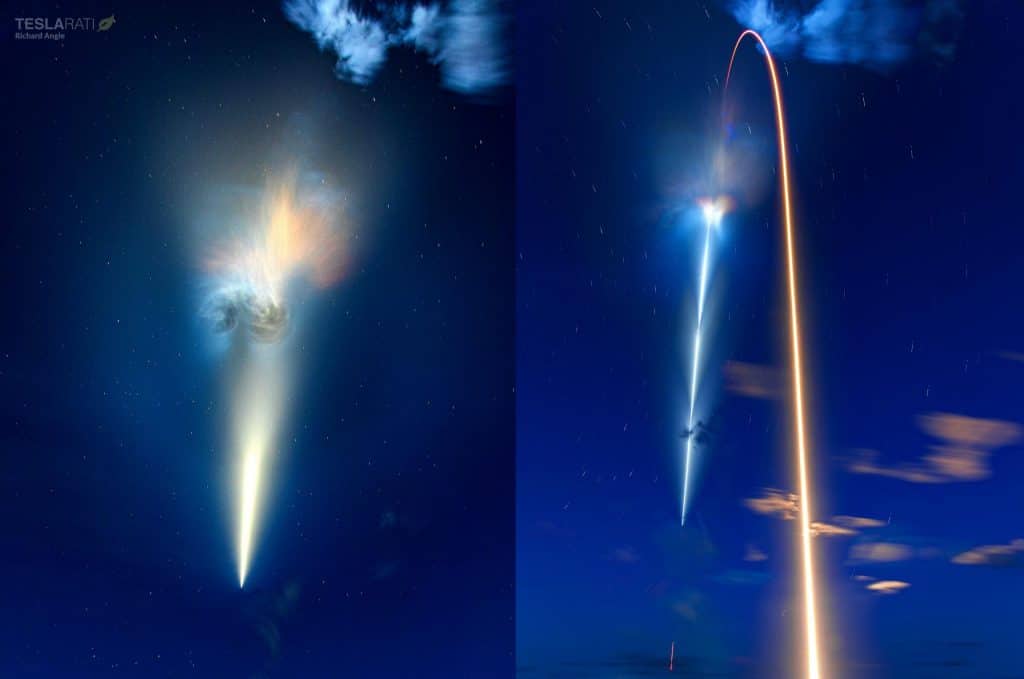
Thanks to the launch window SpaceX and ASI have settled on, CSG-2’s launch could be quite spectacular – and for more than just the crowd-favorite Falcon 9 RTLS landing it will include. Set to lift off just 15 minutes after sunset, the twilight sky (clouds permitting) will be dark blue as Falcon 9 lifts off and climbs into sunlight, backlighting the miles-long exhaust plumes of both stages.
The mission’s RTLS landing will only enhance the effect by adding the interaction of the exhaust plumes of both stages as CSG-2’s Falcon 9 booster flips around and boosts back towards the Florida coast. The sun may even backlight the booster’s exhaust during a reentry burn performed a few minutes after stage separation, hopefully resulting in a spectacular light show that lasts several minutes and is visible for hundreds of miles in any direction.