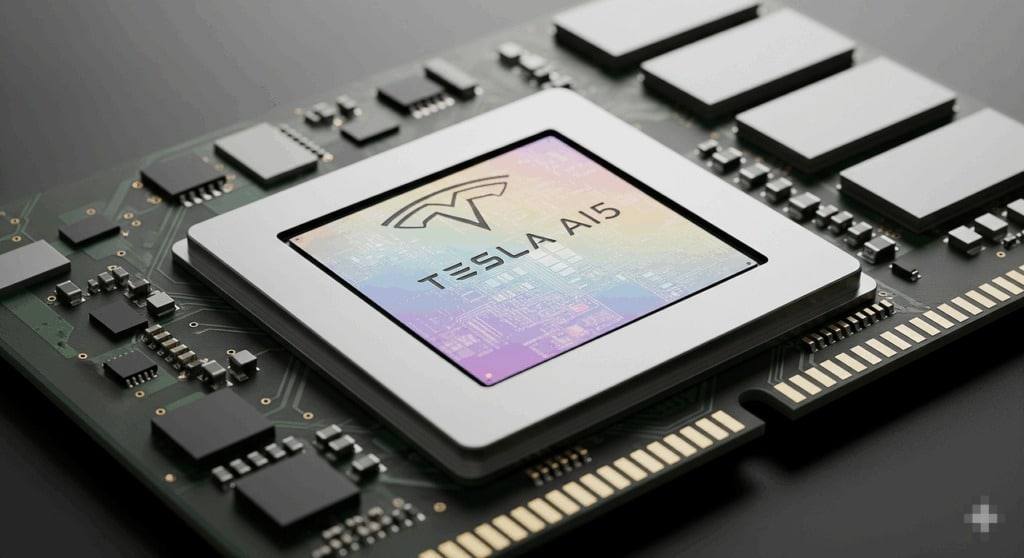
Tesla’s AI5 Chip: The Future of Self-Driving Technology
Key Takeaways
- Tesla’s AI5 chip is the next-gen hardware for its self-driving program and other AI features.
- The chip will be manufactured by Samsung and TSMC at their facilities in Arizona and Texas.
- AI5 is expected to be 40 times faster with 8 times the raw compute and 9 times the memory capacity of AI4.
- Different versions of AI5 from Samsung and TSMC are planned, but the AI software will function identically across them.
- Sample chips are expected next year, with high-volume production projected for 2027.
- Early versions of vehicles, like the Cybercab, will continue to rely on the AI4 chip until AI5 is widely available.
- AI6 is anticipated to offer two times the performance boost, with its production beginning in 2028.
In the rapidly evolving world of automotive advancements, Tesla continues to pave the way with groundbreaking innovations. The latest introduction to their technological arsenal is the AI5 chip, a game-changer for self-driving vehicles and artificial intelligence applications. Here’s a deep dive into what this revolutionary chip holds for the future.
AI5 Chip: A Glimpse into the Future
Tesla’s AI5 chip is slated to replace the current AI4 chips, offering unprecedented enhancements in speed, compute power, and efficiency. This hardware development holds the potential to redefine not just self-driving technology but also pave the way for broader AI innovations.
A Leap in Performance Metrics
The AI5 chip is designed to be a powerhouse. Here’s what sets it apart:
- Speed and Compute Power: AI5 promises a 40x speed improvement over AI4, with 8 times the raw compute capability. This translates to faster data processing and decision-making power which is crucial for autonomous driving.
- Memory and Efficiency: With 9 times the memory capacity and 3 times the efficiency per watt, AI5 allows for handling complex operations with minimal energy consumption.
Manufacturing Prowess: Samsung and TSMC Collaboration
The production of the AI5 chip marks a significant collaboration with two of the industry’s giants, Samsung and TSMC. While both will produce slightly different versions due to the nuances in chip translation to the physical form, the AI software is engineered to deliver consistent performance across both variations.
- Facility Locations: The chips will be manufactured in Arizona and Texas, leveraging the advanced fabrication technologies at these locations.
- Avoiding Past Pitfalls: Tesla’s approach aims to avoid issues like the “Chipgate” scenario faced by Apple’s A9. Through strategic planning, such variance concerns are anticipated to be negligible.
Implementation Timeline: What’s on the Horizon?
Tesla’s roadmap for the AI5 chip is ambitious yet strategically paced:
- Samples and Initial Production: Early samples of the AI5 are expected to be available in the coming year, setting the stage for extensive testing and refinement.
- Volume Production: Full-scale production is targeted for 2027, aligning with Tesla’s broader plans for revolutionizing their autonomous fleet.
- Current Vehicle Integrations: In the interim, Tesla’s new models like Cybercab will continue utilizing AI4 chips, ensuring a steady progression until AI5 becomes mainstream.
Beyond AI5: Future Innovations
Tesla doesn’t plan to stop at AI5. With AI6 on the horizon, which promises a theoretical performance boost by two times, the company is setting its sights on even more sophisticated AI capabilities. This progression is targeted for production in 2028, outlining a future where AI technology in vehicles could reach unprecedented levels of productivity and efficiency.
The Road Ahead
The development of the AI5 chip is a testament to Tesla’s relentless pursuit of excellence in the realm of self-driving technology. It represents a significant stride forward, promising not only to enhance the capabilities of Tesla’s vehicles but also to propel the entire industry towards a new era of AI-powered innovation.